
Surface and Dust Analysis – Mold
Surface and Dust Analysis – Mold
Starting at 285 €
Choose the kit that best suits your needs
Mold can grow in the air, on surfaces, or in dust.
Summary to Help You Make the Right Choice
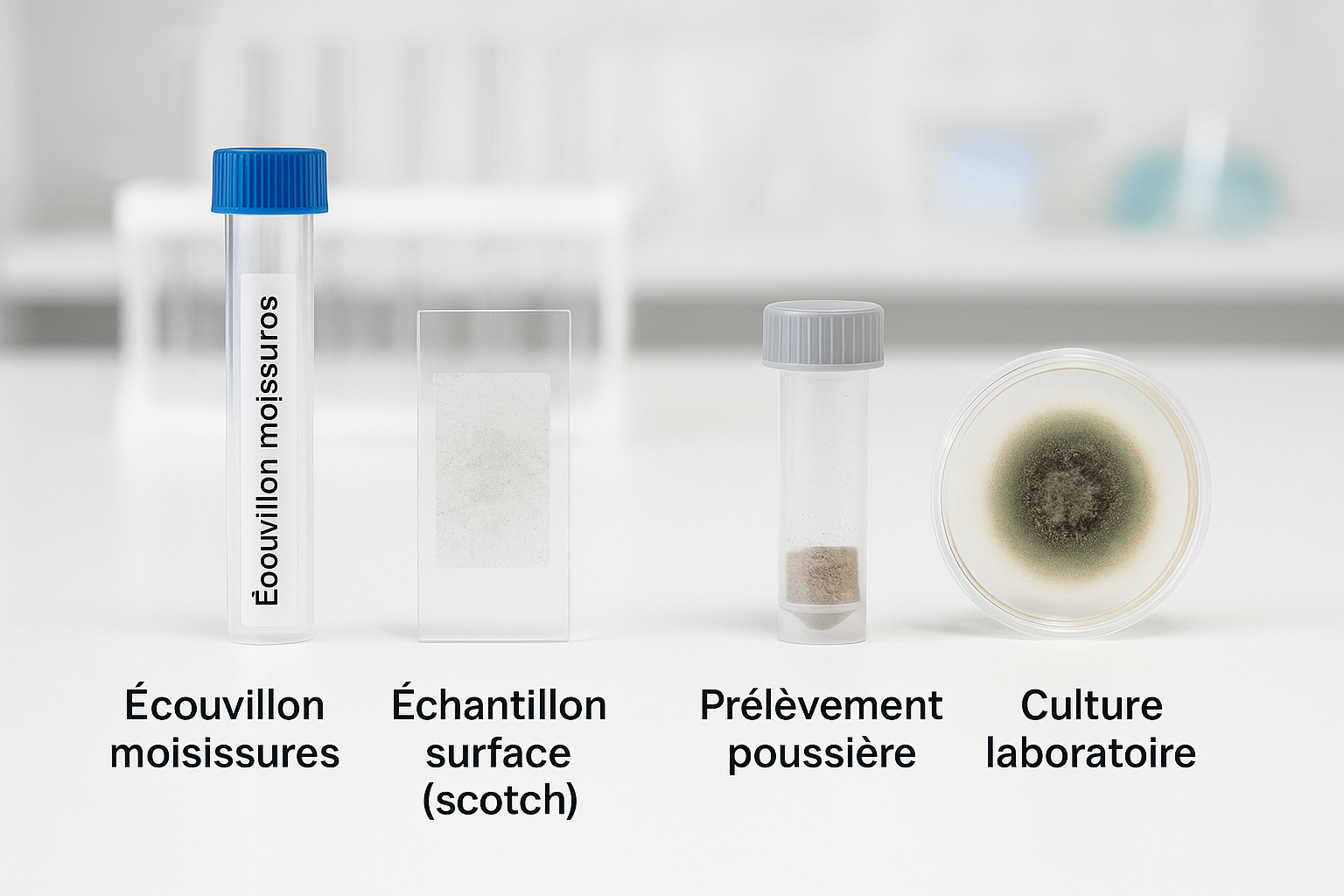
- Scotch: visible mold.
- Swab: mold in hard-to-reach areas.
- Tape and Swab Kit: Comprehensive inspection of visible and hidden areas.
- Dust: Assessment of occupants’overall exposure.
Each kit has a specific sampling method tailored to the source of contamination you wish to analyze
Scotch Mold Removal Kit
To analyze suspicious visible surfaces
- Method: A special adhesive tape is applied to the contaminated surface (wall, wood, plaster, joint, furniture, etc.).
- Objective: To identify mold present in a visible area (black, greenish, or whitish spots).
- Ideal if: you’ve already noticed visible mold and want to know what kind it is.
Mold Swab Kit
To inspect hard-to-reach areas
- Method: Sample collection using a sterile swab (such as a laboratory cotton swab).
- Objective: To detect and identify mold on hard-to-reach surfaces (ventilation ducts, corners, cracks, behind furniture, air conditioning units).
- Ideal if: you suspect contamination that is not visible or is located in enclosed areas.
Scotch Mold Removal Kit + Swab
For a complete view of the surfaces
- Includes both the tape and the swab.
- Allows for the simultaneous analysis of visible mold (using tape) and hidden areas (using a swab).
- Ideal if: you want a comprehensive assessment of your indoor environment, both visible and invisible.
Mold and Dust Kit
To assess chronic exposure through dust
- Method: Collection of settled dust (from floors, carpets, bedding, and furniture).
- Objective: To identify mold present in the overall environment that has accumulated over time.
- Relevance: reflectsthe daily exposure of occupants (children, patients, employees).
- Ideal if: you want to understand the health effects (allergies, asthma, irritation) without any immediate visible signs of contamination.
Health risks associated with mold
Mold in indoor air can pose a real health hazard, even when it is not visible. It releases spores, cellular fragments, and sometimes toxins into the environment, which can cause a wide range of health problems.
1. Respiratory hazards
Mold is a common cause of irritation and respiratory problems:
- Irritation of the nose, throat, and bronchial tubes.
- Dry cough, shortness of breath, tightness in the chest.
- Triggering or worsening of asthma.
- Recurrent sinusitis or bronchitis.
2. Allergic reactions
Fungal spores are powerful allergens:
- Sneezing, stuffy nose, itchy eyes.
- Conjunctivitis, hives, eczema.
- Allergic asthma, long-term sensitization to certain species (Cladosporium, Penicillium, Aspergillus, etc.).
3. Fungal infections (in vulnerable individuals)
Some molds can cause serious infections in people with weakened immune systems:
- Pulmonary aspergillosis.
- Chronic fungal sinusitis.
- Skin or eye irritation.
4. Toxic effects of mycotoxins
Some species, such as Stachybotrys chartarum, can produce mycotoxins:
- Skin irritation, headaches, fatigue, neurological disorders.
- Increased risks in cases of chronic exposure or in buildings heavily contaminated following a disaster.
5. People who are particularly sensitive
Mold has a more serious impact on:
- Infants and young children.
- Older adults.
- People with asthma, allergies, or immunodeficiency.
- People who work in damp or poorly ventilated environments.
Why act quickly?
Even in the absence of visible mold, fungal contamination can develop in dust, building materials, or the indoor air. A targeted analysis can identify the spores responsible and enable the implementation of appropriate solutions: remediation, air purification, humidity control, and renovation of contaminated materials.
Additional information
| Weight | 1 kg |
|---|---|
| Dimensions | 20 × 20 × 4 cm |
| Product type | One-time measure |
| Applications | Mold |
| Quantity | Swab – Hard-to-reach surfaces, Adhesive tape + Swab – All surfaces, Dust, Adhesive tape – Visible surfaces |