
Indoor Air Quality Assessment
Start your assessment
Assess the occupational risks related to indoor air quality in your facilities
In workplaces, indoor air may contain hazardous chemicals resulting from work activities, materials present, products used, or inadequate ventilation.
However, they directly involve the employer’s responsibility for occupational health and safety.
The only way to find out is to measure your environment under real-world conditions.
Without such measurements, it is impossible to objectively assess these risks, complete your DUERP, or implement appropriate preventive measures.
The NatéoSanté assessment allows NatéoSanté to accurately evaluate your teams’ exposure to indoor air pollutants—and take informed action.
Measure the air you breathe
Measuring indoor air quality allows you to assess indoor air pollution and identify the sources of deterioration in your environment.
You start by filling out a questionnaire so that we can fully understand your environment, your challenges, and your needs. Next, we provide you with the Air Coach Pro Formaldehyde sensor and monitor, a connected device that continuously analyzes indoor pollution (Volatile Organic Compounds, carbon dioxide, fine particulate matter PM1, PM2.5, PM10, formaldehyde, etc.).
Detailed Analysis of Your Data
The measurement is taken in the room of your choice—the one that is most representative or most exposed.
Over the course of a week, we collect detailed data on your indoor air quality: levels of chemical pollutants, fine particulate matter, VOCs, and confinement indicators. The sensors we use provide continuous monitoring of air quality and pollutants in your indoor environment.
This data is then analyzed by our indoor air quality engineers to identify sources of pollution and assess your level of exposure. The effectiveness of your ventilation and air circulation systems is also evaluated.
This analysis allows us to accurately assess indoor air pollution and identify situations that require action.
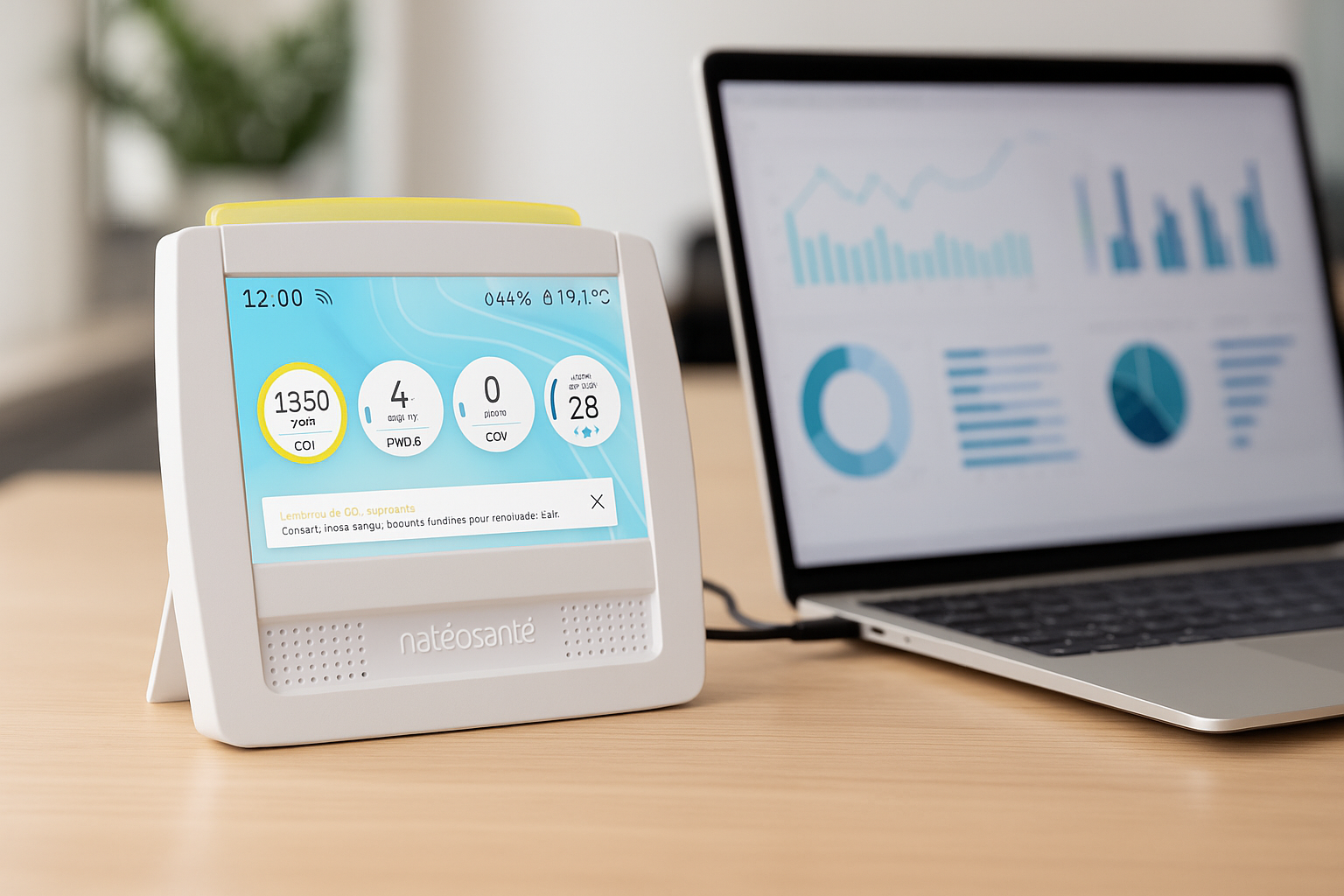
A comprehensive analysis report & a customized action plan
Following our analysis, we provide you with a clear, comprehensive, and detailed scientific report. Our engineers will indicate the levels of the various pollutants detected in your indoor air and directly compare them to the permitted regulatory limits.
Based on the pollutants detected and any regulatory limits exceeded, our team of experts recommends best practices and, if necessary, NatéoSanté solutions to reduce the identified pollutants in your indoor environment.
This ensures your facility complies with health and safety regulations. Your employees’ performance improves, your health and that of your visitors is protected, and your business is safeguarded!
Retail price for the comprehensive diagnostic service: 720€ (excluding tax)
Your 6-step air quality assessment
Simple, fast, and hassle-free
The NatéoSanté diagnostic tool NatéoSanté designed to fit seamlessly into your daily routine. It requires no technical expertise, no complex setup, and no interruption to your work.
1 – Online Ordering
You can confirm your diagnosis in just a few clicks. Our teams will then assess your needs.
2 – Receiving the Air Coach
The sensor is delivered to your premises, ready to use, along with simple instructions.
3 – Measure for 7 days
The device continuously measures indoor air quality in the selected room.
4 – Simplified Returns
A prepaid return label is included in the package to make returning the item easier.
5 – Scientific analysis
Your data is analyzed by our indoor air quality engineers.
6 – Video presentation
You will receive a comprehensive report, clearly explained and accompanied by specific recommendations.
What you’ll receive after the assessment
The assessment goes beyond a simple measurement. It provides you with a clear picture of your environment and concrete recommendations so you can make informed decisions.
A comprehensive report
- Detailed charts of the indicators
- Levels measured for each pollutant
- Clear data analysis
A business perspective
- Interpretation tailored to your business
- Identifying high-risk situations
- Assessing Your Exposure
Recommendations
- Reminder of best practices
- Priority actions to be implemented
- Solutions tailored to your environment
Indoor Air Quality Assessment: A Professional and Quantifiable Approach
Indoor air quality is a major concern in workplace environments.
Depending on the type of activity, usage patterns, and ventilation conditions, the air may contain various pollutants such as volatile organic compounds (VOCs), carbon dioxide (CO₂), fine particulate matter (PM1, PM2.5, PM10), and formaldehyde.
These pollutants are generally invisible and go unmeasured, even though they can affect working conditions, employee health, and regulatory compliance.
Without data, it is impossible to objectively assess these exposures and make appropriate decisions.
An indoor air quality assessment allows for an accurate evaluation of pollution levels, the identification of potential sources, and the collection of reliable data to guide the actions to be taken.
Measuring indoor air quality allows for an accurate assessment of indoor air pollution and helps identify sources of environmental degradation.
In many cases, indoor air quality can be affected by various air pollutants without this being noticeable in everyday life.
Why assess occupational risks related to indoor air quality?
🔷 Identify sources of pollution
Understand the source and nature of the pollutants—particularly chemical agents—to which your teams are exposed on a daily basis.
🔷 Assess the level of occupational exposure
Compare the measured concentrations with the occupational exposure limits (OELs) established by regulation.
🔷 Comply with regulatory requirements
Have actionable data to populate your Single Occupational Risk Assessment Document (DUERP) and meet the requirements of the Labor Code regarding chemical risk prevention.
🔷 Develop an appropriate prevention plan
Implement concrete measures tailored to your environment and in line with INRS recommendations.
This assessment provides a reliable picture of indoor air quality and air pollution in your workplace.

A risk assessment that meets your occupational health and safety requirements
Our approach is based on measurements taken under real-world working conditions and the analysis of data collected by professional sensors.
In particular, it allows you to:
- measure levels of the main indoor air pollutants: CO₂, volatile organic compounds (VOCs), fine particulate matter (PM1, PM2.5, and PM10), and formaldehyde
- compare the results with occupational exposure limits (OELs) and applicable regulatory thresholds
- analyze variations based on activity and occupancy of the premises
- assess the effectiveness of ventilation and air circulation in light of the requirements of the Labor Code
- identify situations that require corrective action as part of your risk prevention process
The data is analyzed by our air quality engineers to provide you with clear recommendations tailored to your business and suitable for inclusion in your DUERP.
Frequently Asked Questions About Indoor Air Quality Testing
How long does an indoor air quality assessment take?
Indoor air quality measurements are taken over a period of approximately 7 days in order to obtain data that accurately reflects your activities and environment.
Should you stop working while the diagnosis is being made?
What is indoor air pollution?
Indoor air pollution refers to the presence of pollutants such as fine particulate matter, VOCs, or CO₂ in an enclosed space. It can vary depending on the activity, ventilation, and how the space is used.
Can the assessment contribute to my Single Document for the Assessment of Occupational Risks?
Which air pollutants are measured?
An indoor air quality assessment allows for the analysis of the main pollutants present in workplace environments, including:
- carbon dioxide (CO₂), a measure of containment
- fine particulate matter (PM1, PM2.5, PM10)
- volatile organic compounds (VOCs)
- formaldehyde
- certain chemical pollutants associated with the activity
These measures make it possible to accurately assess indoor air pollution and identify the sources of poor air quality.
What does the diagnostic report include?
Why measure indoor air quality?

101 rue Gustave Eiffel
44680 SAINT-HILAIRE-DE-CHALEONS
France
Hours
Monday through Friday
9:00 a.m. – 1:00 p.m.
2:00 p.m. – 5:00 p.m.