
Dentists, dental practices, and dental technicians: air quality assessment & workplace safety
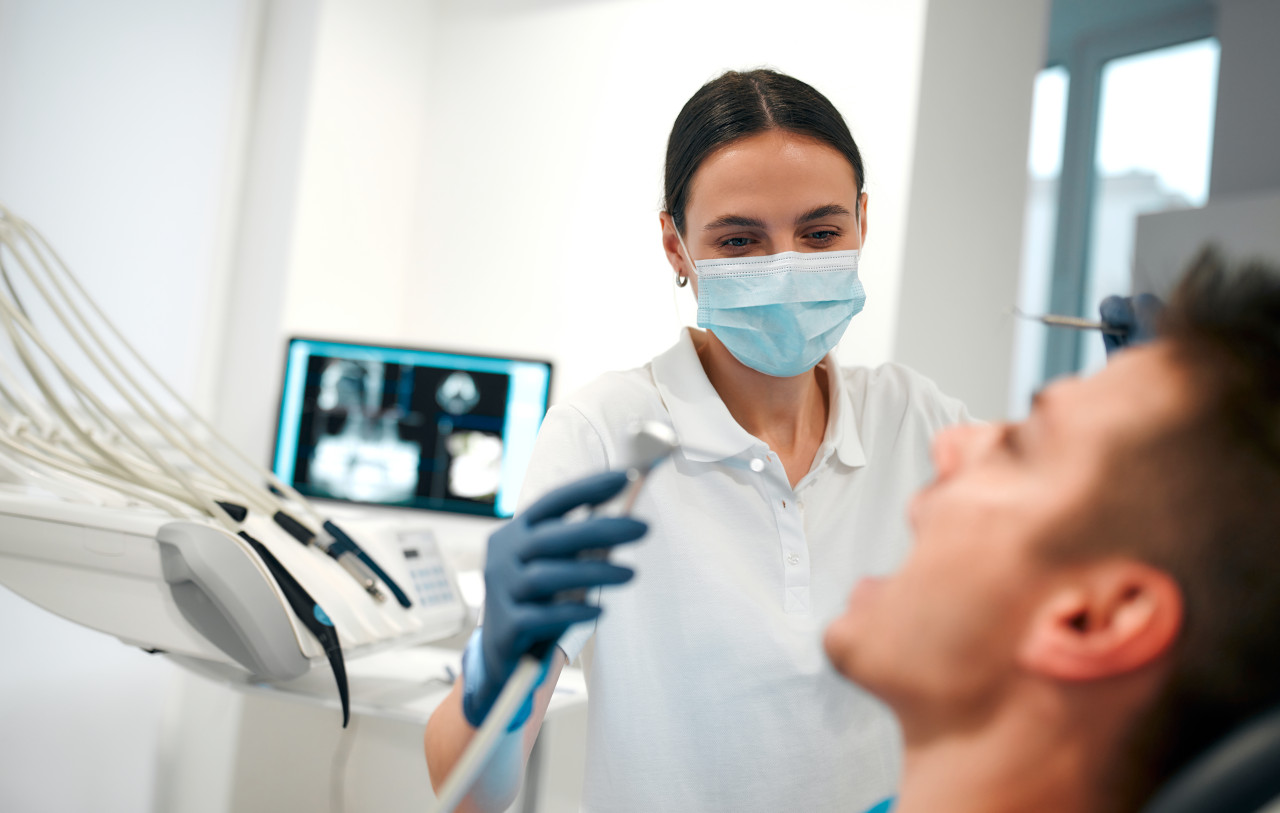
Comprehensive expertise, from needs analysis to the implementation of the right solution
Every dental procedure exposes your dental team to invisible pollutants.
The Labor Code requires that these chemical and biological risks be assessed (Art. R4412-1) and documented in your DUERP.
Invisible but measurable, we support you every step of the way—from analyzing your operations to implementing a solution tailored to your specific pollutants.
7 days of Air Coach measurements + analysis by the NatéoSanté database NatéoSanté precise risk assessment and the right equipment.
What pollutants do we measure in our assessment of your veterinary clinic?
Pollutants specific to dental offices
- Biological aerosols (turbine): projection of biological droplets (blood, saliva) during medical procedures. PM1/PM2.5 particles generated by high-speed turbines, capable of penetrating the alveoli.
- Resins/methacrylates: volatile monomers in composite resins. Major occupational sensitizers: asthma, dermatitis, irritation. Cumulative exposure has been documented among dental surgeons.
- Formaldehyde, IARC Group 1 carcinogen: found in certain disinfectants, impression preservatives, and materials. OEL: 0.3 ppm (May 2023 decree).
- Mercury / amalgam fillings: mercury vapors released during the removal or polishing of old amalgam fillings. OEL: 0.02 mg/m³. Neurotoxic, bioaccumulative.
- Disinfectants/biocides: glutaraldehyde, quaternary ammonium compounds, alcohols. Chronic respiratory irritants in confined spaces.
- CO₂ & lockdown: offices are often small. CO₂ > 1000 ppm = fatigue, decreased concentration, an indicator of lockdown.
Mapping Air Quality Risks by Dental Area
Each area of your facility has its own pollution profile. Our assessment helps you prioritize actions:
| Practice Area | Risk level | Targeted pollutants |
| Treatment chair | review | Turbine aerosols, methacrylates, biocides |
| Dental Laboratory | review | Grinding dust, resins, solvents |
| Operating Room | moderate | Aerosols, disinfectants, biocides |
| Sterilization Room | to watch out for | Glutaraldehyde, biocides, VOCs |
| Waiting room | low | CO₂, lockdown |
Occupational hazards in dental offices: Who is at risk of air pollution?
- Dental surgeons: direct exposure to aerosols, methacrylates, and disinfectants. Documented occupational asthma caused by methacrylates.
- Dental assistants: exposure to a variety of substances: dental care, sterilization, grinding. Cumulative allergy risk (disinfectants, resins).
- Dental technicians: PM2.5 dust, resins, solvents. Documented occupational pneumoconiosis.
- Reception staff, secretaries: CO₂ levels in the waiting room, residual VOCs. The indoor air quality assessment reassures both patients and administrative staff.
Recognition as an occupational disease
These exposures are directly related to tables No. 43 (aldehydes), No. 66 (allergic asthma), and No. 84 (organic solvents) of the general regulations.
Glossary of Terms Related to Indoor Air Quality (IAQ) in Dental Settings
- 8-hour OEL / OEL: occupational exposure limit (8-hour average) at the workstation.
- CMR: carcinogenic, mutagenic, or toxic to reproduction.
- MSDS: Material Safety Data Sheet for the chemical product; required at the workplace.
- CPE / PPE: collective protective equipment (priority) / personal protective equipment.
What are the regulatory requirements for your dental practice?
The Labor Code requires all practice managers to assess and document chemical and biological risks.
The Regulatory Action Plan for Your Compliance
To meet your obligations (including the assessment of risks associated with dental resins, disinfectants, amalgams, and aerosols), chemical risk prevention in the workplace must follow a strict four-step methodology:
- Workplace Risk Assessment (Art. R4412-1): A legal requirement to identify hazardous substances, routes of exposure, and affected employees. This information must be included in your DUERP starting with the first employee and updated annually.
- Measuring occupational exposure: conducting ongoing monitoring to compare your practice’s actual concentrations with regulatory limits and follow INRS recommendations (biological monitoring for mercury).
- Substitution and collective protection: prioritize assessing opportunities to eliminate hazardous substances. If this is not possible, implement a collective prevention measure: capture aerosols, mercury vapors, methacrylates, and VOCs at the source before they are released into the air (Cramif and INRS recommendations).
- Enhanced medical monitoring: Rigorous documentation of exposure levels for the occupational physician is mandatory for employees exposed to CMR agents (formaldehyde, mercury) or subjected to physically demanding working conditions.
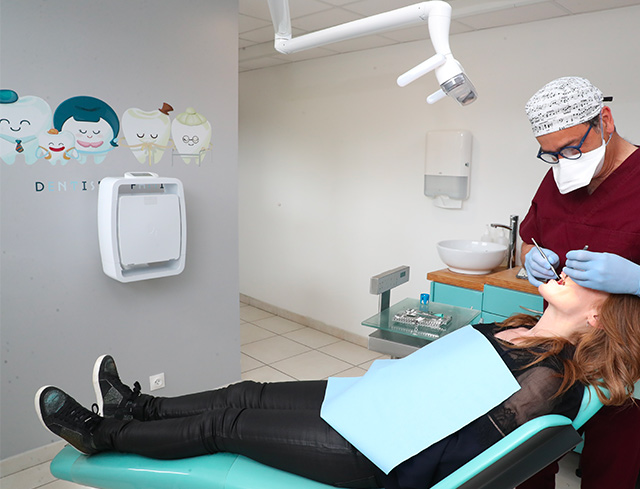
Summary of Exposure Limits and Risks in Dental Practices
| Chemical / Agent | Regulatory exposure limit | Major health risks | Risk Prevention (EPC) |
| Methacrylates / Resins | INRS threshold: 1 ppm | Occupational asthma, dermatitis | Data collection at the source (EOLIS) |
| Formaldehyde | OEL 0.3 ppm (May 2023 decree) | IARC Group 1 carcinogen, skin irritant | Substitution + collective protection |
| Mercury (amalgams) | OAA 0.02 mg/m³ | Neurotoxic, bioaccumulative | Point-of-use capture + dedicated filtration |
| Disinfectants / Biocides | According to suppliers' MSDSs | Chronic irritation of the respiratory tract | Active ventilation + PPE |
| PM1/PM2.5 aerosols | WHO threshold | Risk of infection, alveolar penetration | HEPA H13 filtration (EOLIS) |
What does NatéoSanté air quality diagnostic report NatéoSanté dentists include?
To support you in implementing this action plan, ensure compliance, and protect your staff, our comprehensive audit provides you with concrete, actionable scientific data:
- Continuous 7-day monitoring: precise analysis of the presence of methacrylates, formaldehyde, mercury vapors, VOCs, PM1/PM2.5 aerosols, and CO₂, room by room.
- Expert analysis and AI: Our algorithms cross-reference your results with our 15 years of dental expertise data to identify your specific risks.
- Detailed graphs: clear visualization of exposure peaks throughout the week, direct comparison with legal thresholds, and identification of pollution sources.
- Data ready for the DUERP: You’ll receive key indicators—quantified and official—ready to be incorporated directly into your Single Document to demonstrate your due diligence.
- Eolis Air Manager Recommendation: a customized recommendation for the exact air purifier model and filter configuration tailored to your specific pollutants.
Case Study: From Assessment to Compliance for a 30-square-meter Dental Office
Representative case study based on the NatéoSanté knowledge base, which draws on 15 years of IAQ assessments in dental practices. One dentist and one assistant, ~150 procedures per week, including daily scaling, restorative care, and amalgam removals.
The context of the case study on air quality in a dental office
Dental practice in an urban area, 30 m² of floor space (1 main chair + sterilization area), with a recently installed dual-flow mechanical ventilation system. The team consists of1 dentist and 1 dental assistant, working an average of 9 hours a day, 5 days a week. General practice with a mix of services: 40 to 50 ultrasonic cleanings per week, 25 to 30 restorative treatments using composites and bonding, 3 to 5 removals of old amalgam fillings per week, plus daily sterilization using disinfectants.
Reason for the diagnosis
Recurring headaches at the end of the day for the dentist, eye irritation and a scratchy throat for the assistant after long sessions of conservative dental care, and a lingering smell of disinfectants. The practice wants to objectively document these exposures in the DUERP and prepare for the new formaldehyde occupational exposure limit (Decree 2023).
The assessment: 7 days of continuous monitoring with Air Coach
An Air Coach Pro sensor was positioned in the treatment room at the practitioner’s breathing height and set up to monitor a full week of actual activity. Continuous measurements were taken every 5 minutes: CO₂, total VOCs, formaldehyde, fine particulate matter (PM2.5), temperature, and humidity. Formaldehyde peaks correlated with disinfection and sterilization phases. No intervention during the 7 days.
- Formaldehyde, non-compliant: maximum peak of 90 µg/m³, or 3 times the 8-hour OEL (30 µg/m³, Decree 2011-1727). Average 44 µg/m³ – consistently above the threshold. CMR1B carcinogen (IARC) – documented risk of nasopharyngeal cancer. Source: surface disinfectants and cold sterilization.
- Solvents & Resins (VOCs), non-compliant: maximum peak of 5.1 ppm, or 5 times the INRS threshold (1.0 ppm). Average: 0.7 ppm. Methacrylates (MMA, HEMA, Bis-GMA) – allergens & neurotoxins. Occupational asthma, contact dermatitis, and headaches have been documented.
- Aerosols / CO₂, proper ventilation: maximum single-point peak of 1,509 ppm (1× the 1,000 ppm threshold), average of 561 ppm. The mechanical ventilation system effectively removes CO₂ and aerosols over time.
Biological indicator: if CO₂ is high = persistent viral/bacterial aerosols. - Fine particulate matter (PM), excellent: maximum peak of 19 µg/m³, just above the WHO threshold (15 µg/m³). Average 4 µg/m³. Surgical suction is effective for grinding particles (plaster, ceramic, zirconia). However, it does not capture chemical vapors—see Formaldehyde and VOCs.
The VMC system vents, but does not treat the chemicals
The mechanical ventilation system is effective at controlling CO₂ and fine particulate matter, with acceptable non-compliance rates (13.2% and 2.7%). However, it is completely ineffective against formaldehyde and resin solvents, which are chemical molecules that can only be absorbed by a system equipped with high-density activated carbon filtration. Result: formaldehyde exceeds its threshold 93.2% of the time, and VOCs peak at 5 times the limit value. The team is chronically exposed, without realizing it.
Overall Exposure Index
88/100
Contaminated environment. Critical situation. Dental procedures generate persistent chemical pollution. This is typical of dental offices where mechanical ventilation removes CO₂ and particles but does not treat solvents or formaldehyde—levels of which exceed safety thresholds more than 90% of the time.
Our recommendation: Eolis Air Manager 600 S
The CMV system is effective for CO₂ and particulate matter, but it is structurally incapable of capturing chemical molecules: no ventilation system, no matter how efficient, can absorb formaldehyde or methacrylates—a high-density activated carbon filter is required for that. Analysis of the NatéoSanté decision matrix NatéoSanté formaldehyde non-compliant 93.2% of the time, VOCs at 5× the occupational exposure limit, 30 m² floor area, staff exposed 9 hours/day) points to the EOLIS Air Manager 600 S model with a dedicated dental filter, as a supplement to the existing CMV—not as a replacement.
- Recommended airflow (CADR 350 m³/h): air is recirculated 6 times per hour in a 30 m² room
- The DENT Filter developed by NatéoSanté: H13 HEPA media (EN 1822 standard) for biological aerosols generated during scaling + high-density activated carbon specifically designed to target methacrylates and formaldehyde.
- Deep Clean Technology: a patented active decontamination feature (Air + Surfaces) that can be programmed to run at night, essential for addressing persistent aerosols and residual formaldehyde
This practice is not an isolated case. The majority of dental practices NatéoSanté by NatéoSanté show similar levels of formaldehyde and resin solvent exposure, without realizing it, because their mechanical ventilation systems give them a false sense of security: while mechanical ventilation is effective at containing particles, it is unable to capture chemical molecules. Only an objective assessment can reveal what remains invisible today—regular patients’ olfactory thresholds are saturated, and no conventional system provides real-time alerts.
Beyond regulatory compliance, this is a direct investment in the well-being of the team and the quality of care. Clinics equipped with these systems report fewer end-of-day headaches for practitioners, a noticeable improvement in the work environment for assistants, and a more positive perception among patients who are sensitive to odors and hygiene issues.
EOLIS Air Manager: Source-based air sampling for collective protection
The Labor Code mandates source capture as the primary collective protective measure against hazardous chemical agents. Positioned as close as possible to the dental chair, the Eolis captures aerosols, mercury vapors, and VOCs before they spread throughout the treatment room.
Dedicated dental filter:
- Includes Air Coach Pro: real-time alerts · Remote monitoring · DUERP traceability
- Proactive maintenance included: NatéoSanté notified remotely and ships our certified dental filters and UV-C lamps before they become saturated—you don’t have to do a thing
- Certified dental filters developed by NatéoSanté
- UV-C decontamination lamps

An all-inclusive operational leasing plan
Choose peace of mind regarding technology and compliance with our leasing option, which is 100% tax-deductible:
- Includes the Air Coach Pro: real-time monitoring, visual alerts, remote monitoring, and data tracking for your DUERP.
- NatéoSanté Proactive Maintenance: We monitor the condition of your equipment remotely. Your VET-certified filters and replacement UV-C lamps are automatically shipped to you before they become saturated. You don’t have to do a thing.
- Full warranty: includes damage and theft coverage, after-sales service, and return to the repair shop.
Start your assessment
NatéoSanté: 15 years of expertise in indoor air quality (IAQ)
For the past 15 years, NatéoSanté the largest database of indoor air quality data by industry in France. This unique sector-specific expertise—integrated into an AI-powered analysis engine—enables recommendations of unparalleled precision.
Our Core Values and Key Figures
- 2009: The year the company was founded in Saint-Hilaire-de-Chaléons (Loire-Atlantique).
- 100% French: The Air Coach and Eolis Air Manager are designed and manufactured in France, ensuring rigorous quality control and certified performance.
- 15 years of data: a unique historical record of IAQ data by industry sector, allowing you to compare your measurements to thousands of similar assessments.
- Patents & Innovation: We hold several patents on our measurement and processing technologies, driven by ongoing R&D.
- Global reach: recognized expertise and equipment exported to more than 50 countries.
Frequently Asked Questions: Audits and Air Safety in Dental Practices
What specific pollutants are measured in a dental office?
Does the mercury in dental amalgams still pose a risk?
Why choose the Eolis over a standard air purifier?
Does the 7-day diagnosis disrupt the dental practice's operations?

101 Gustave Eiffel Street
44680 SAINT-HILAIRE-DE-CHALEONS
France
Hours
Monday through Friday
9:00 AM – 1:00 PM
2:00 PM – 5:00 PM