
Businesses, offices, and commercial spaces: air quality assessment and occupational safety

Help promote your employees' well-being and protect their health
Office air has no smell, no color, and no shape.
But it does affect concentration, sleep, absenteeism, and employer brand.
7 days of Air Coach measurements + analysis by the NatéoSanté database NatéoSanté precise risk assessment and the right equipment.
Six pollutants, a reality in the service sector
Each space accumulates emissions that build up in rooms that are often poorly ventilated, directly affecting employees’ respiratory health.
- CO₂: Indoor Air Quality: Carbon dioxide is the primary indicator of air exchange in open-plan offices. At levels above 1,500 ppm, a measurable drop in concentration can lead to fatigue, headaches, and respiratory problems.
- VOCs: Furniture & finishes: volatile organic compounds, formaldehyde, and other chemicals emitted by particleboard, carpeting, paint, and adhesives. High emissions during the first six months after installation; these can trigger asthma and allergies.
- Toners / Printers: ultrafine particulate matter (PM0.1), volatile organic compounds, and ozone emitted by laser printers and photocopiers during toner combustion.
- Cleaning products: spikes in chemical levels and VOCs during cleaning operations, which often take place outside of business hours, leaving little time to ventilate restroom facilities before staff arrive.
- Air Fresheners / Fragrances: diffusers, toilet deodorizers. Often mask an underlying indoor air quality (IAQ) problem.
- Temperature & Humidity: Improperly balanced air conditioning and ventilation promote mold and dust mites. Outdoor air pollution (fine particulate matter, ozone, nitrogen dioxide) enters through the mechanical ventilation system and degrades indoor air quality. Relative humidity (RH) < 30% or > 70% = poor indoor air quality.
Mapping air quality risks by area
Each area of your facility has its own pollution profile. Our assessment helps you prioritize actions:
| Clinic Area | Risk level | Primary pollutants targeted |
| open-plan office | moderate | CO₂ · VOCs from furniture · Particulate matter |
| copying services | moderate | Toners · PM0.1 · VOCs |
| Meeting rooms | to watch out for | CO₂ spikes during meetings · Lockdown |
| break area | to watch out for | CO₂ · Odors · Humidity |
| lobby / hallway | low | Residual VOCs · Particles |
Occupational Hazards in Veterinary Clinics: Who Is Exposed to Air Pollution?
Not all employees are exposed to the same risks. Identifying employee profiles makes it possible to target initiatives and structure internal occupational health and safety communication.
- Employees in open-plan offices: ongoing exposure to CO₂ and VOCs. Fatigue and decreased concentration are often attributed to other causes.
- Management: Small meeting rooms: CO₂ levels exceed 2,000 ppm during long meetings. This has a direct impact on the quality of decisions.
- Administrative staff: proximity to printers and photocopiers. Ultrafine particles and VOCs from toner: daily exposure often goes unnoticed.
- QSE/HR Managers: factual data for the DUERP, IRP negotiations on working conditions, QSE certifications.
What are the regulatory requirements in the office?
- Labor Code, Art. R4412-1: Hazardous Chemical Agents
- DUERP required starting with the first employee: annual update (INRS)
- Formaldehyde OAK 0.3 ppm: Decree of May 25, 2023
- QAI Decree for Public Access Buildings: Open to the Public
- Inter-industry Agreement on Quality of Life at Work
- HQE, WELL, and BREEAM Certifications: Indoor Air Quality (IAQ) as an Evaluation Criterion
What does the NatéoSanté diagnostic report NatéoSanté the service sector include?
A contribution to your DUERP:
- factual data for risk assessment
- enforceable measures that comply with standards
- concrete preventive action (EOLIS Air Manager)
- QVCT sales pitch: employer brand
- Support for HQE / WELL / BREEAM initiatives

Office Air Quality: A Clear Explanation
Indoor Pollution and Indoor Air Quality
Added to this is outdoor air pollution (fine particulate matter PM2.5 and PM10, ozone, nitrogen dioxide NO₂, and carbon monoxide), which enters through the mechanical ventilation system (MV). Regular ventilation helps refresh the indoor air, but without proper filtration, it can introduce new outdoor pollutants.
Effect on respiratory health
High levels of carbon dioxide impair cognitive function and cause headaches and fatigue. When fine particulate matter reaches the alveoli, it contributes to long-term cardiovascular disease. Measuring air quality is therefore an essential public health measure.
Ventilation and air exchange
But ventilation isn’t always enough: if the outside air itself is polluted (in dense urban areas or near major roads), HEPA and activated carbon filtration becomes necessary to treat both the pollution in the incoming air and the substances emitted indoors.
Key indicators and thresholds
Continuous monitoring over several days is necessary to identify pollution spikes linked to specific activities (meetings, cleaning, printing) and persistent sources. This is exactly what the NatéoSanté Air Coach assessment offers NatéoSanté 7 days of measurements, a comparative analysis against our database of over 15 years of sector-specific data, and a report that can be used for the DUERP.
Case Study: When Data from
Provides Insight into What Teams Are Experiencing
This case study is a representative summary based on more than 15 years of NatéoSanté assessments NatéoSanté commercial settings. The data presented are averages, the settings have been anonymized, and all correlations shown have been observed in real-world scenarios at comparable sites.
The context of the case study on air quality in an open-plan office
A 200-square-meter open-plan office space housing 25 employees in a building constructed in the 2000s with central air conditioning. The furniture and carpeting are 8 months old, and the open-plan office is located 80 meters from a major road in the city center.
Management requested an assessment following several reports from the team: a sensation of stale air at the end of the day, intermittent unpleasant odors, an increase in allergies during the spring, and two employees with asthma reporting worsening symptoms.
No measurements had been taken previously—indoor air quality had never been objectively assessed.
The diagnosis: 7 days of continuous monitoring
5 indicators monitored continuously, day and night:
- CO2critique: Peak level of 1,850 ppm recorded at 11 a.m. on Tuesday during a meeting (8 people in a closed room). Comfort threshold: 1,000 ppm — Alert threshold: 1,500 ppm. Significant crowding; mechanical ventilation insufficient for the occupancy density.
- Total VOCs: Background level of 800 µg/m³ every morning, persisting into the night. WHO threshold: 300 µg/m³. Continuous emissions from new carpets and composite furniture, toilet deodorizers, and cleaning products
- Formaldehyde: Monitor closely. Peak level of 0.18 ppm every Monday morning before opening. TWA: 0.3 ppm — Odor threshold: 0.1 ppm. Accumulation over the weekend (with windows closed) emitted by composite panels in the offices
- Fine particulate matter (PM2.5), critical: Peak levels during rush hour (8 a.m.–9 a.m., 5 p.m.–7 p.m.) reaching up to 32 µg/m³ indoors. WHO annual threshold: 5 µg/m³. Outdoor air pollution (nearby road) entering through the mechanical ventilation system without adequate filtration
- Humidity to monitor: Average 27% RH in winter during heating season
Comfort range: 40–60%. Air that is too dry: dry eyes, respiratory irritation, conditions conducive to allergies
When every feeling finds its explanation
The Air Coach report made it possible to objectively link the team’s feedback to the recorded measurements. Here are a few examples below.
- Widespread fatigue at the end of the day: confirmed by CO₂ levels exceeding 1,500 ppm between 2:00 p.m. and 5:00 p.m. Above this threshold, there is a documented decline in cognitive performance and drowsiness.
- Morning headaches: linked to peak formaldehyde levels on Monday mornings (accumulation over the weekend) and high background levels of VOCs. Well-documented effects on the mucous membranes of the eyes and respiratory tract.
- Asthma exacerbation: two employees with asthma were exposed to fine particulate matter (PM2.5) levels exceeding WHO thresholds during rush hour—polluted outdoor air entered through the mechanical ventilation system, which lacked HEPA filtration.
- Intermittent odor-related discomfort: associated with spikes in VOC emissions from new carpeting and automatic air fresheners in restrooms. The perception of odor often precedes objective measurement.
- Increase in allergies: a combination of low humidity (27%) + VOCs + fine particulate matter. Dry air irritates the mucous membranes, making them more permeable to allergens and airborne chemicals.
- Eye and throat irritation: three causes identified: formaldehyde, total VOCs, and low humidity. Cumulative effects on the upper respiratory tract, particularly pronounced among employees working more than 8 hours a day.
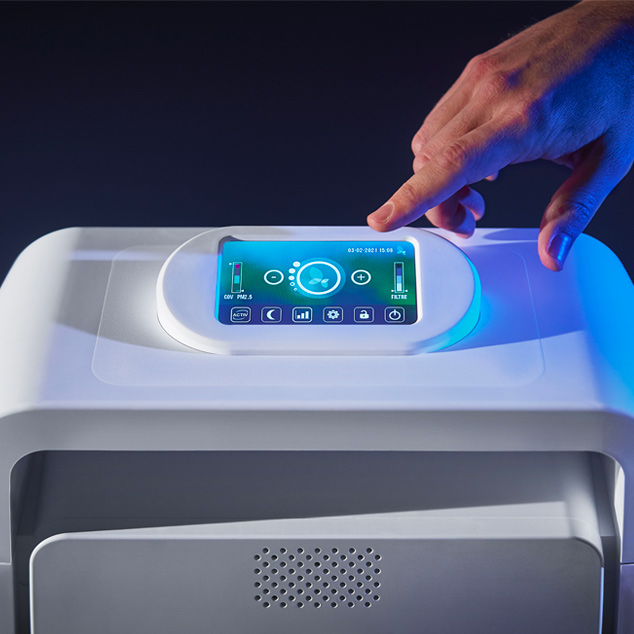
From measurement to collective protection
Actions Taken
- Installation of 2 EOLIS Air Manager 1200 units with H13 HEPA filters and activated carbon, calibrated for the identified pollutants
- Adjustment of mechanical ventilation to achieve 25 m³/h per occupant (Labor Code R4222-6)
- Elimination of automatic air fresheners; replacement with cleaning products certified as low in VOC emissions
- Incorporation of measures and recommendations into the DUERP (Single Risk Assessment Document)
Results measured at 3 months
Start your assessment
NatéoSanté: 15 years of expertise in indoor air quality (IAQ)
Over the past 15 years, NatéoSanté built the largest industry-specific QAI database in France. This unique industry expertise, combined with our AI-powered analysis engine, enables us to provide recommendations of unmatched accuracy for the veterinary sector.
Our Core Values and Key Figures
- 2009: The year the company was founded in Saint-Hilaire-de-Chaléons (Loire-Atlantique).
- 100% French: The Air Coach and Eolis Air Manager are designed and manufactured in France, ensuring rigorous quality control and certified performance.
- 15 years of data: a unique historical record of IAQ data by industry sector, allowing you to compare your measurements to thousands of similar assessments.
- Patents & Innovation: We hold several patents on our measurement and processing technologies, driven by ongoing R&D.
- Global reach: recognized expertise and equipment exported to more than 50 countries.
Frequently Asked Questions: Office Air Quality Audits and Safety
What are the symptoms associated with poor air quality in the office?
What pollutants are measured in offices?
Does poor air quality really affect productivity?
Why choose the Eolis Air Manager over a traditional air purifier?
Is this solution suitable for large open-plan spaces?

101 Gustave Eiffel Street
44680 SAINT-HILAIRE-DE-CHALEONS
France
Hours
Monday through Friday
9:00 AM – 1:00 PM
2:00 PM – 5:00 PM