
Hospitals and clinics: air quality assessment & occupational safety

Indoor air quality in hospitals and clinics: delegated and supervised
NatéoSanté, a French expert in medical air quality for 15 years, offers a unique comprehensive solution in over 60 countries: EU-certified absolute purification, 24/7 connected monitoring, and 100% delegated management to ensure your facility’s compliance and the protection of your most vulnerable patients.
The atmosphere in a hospital ward is never neutral
Air quality in healthcare settings involves actively managing four categories of pollutants found in healthcare facilities: respiratory viruses, highly resistant bacteria, chemical healthcare pollutants (anesthetic gases, disinfectants, formaldehyde, cytotoxic agents), and fine biological particles. It is based on three pillars: minimum HEPA H13 filtration, active treatment (ozone, UV-C, photocatalysis), and continuous monitoring.
Every day, the same volume of air circulates through waiting rooms, hallways, and utility areas. It continuously carries pathogens: respiratory viruses (coronaviruses, influenza, RSV), emerging highly resistant bacteria (E. coli, E. coli O157:H7, Acinetobacter baumannii), and fungal spores in immunocompromised areas.
The Andes hantavirus alert in the spring of 2026 served as a reminder of a broader reality: confined communal spaces act as amplifiers of disease. Of the 38 known strains of hantavirus, the Andes strain is the only one with documented human-to-human transmission, primarily during the prodromal phase. Beyond this specific case, official recommendations converge on the same priority: ventilate and actively treat the air in spaces occupied for extended periods.
From a chemical standpoint, the risk is just as real: glutaraldehyde, formaldehyde, residual anesthetic gases, VOCs from disinfection, and cytotoxic drugs in pathology or preparation areas. Conventional ventilation dilutes these substances; it does not treat them.
Between HEPA H13 filtration, which captures particles, and active treatment, which destroys them, there is a step that most facilities have not yet taken.
The only professional air purifier in France that combines medical-grade filtration with a patented active ozone treatment at a controlled concentration
- Human Presence Mode: Low Concentration, Filtration Supplement: While the room is occupied, the Eolis Air Manager releases a controlled, strictly regulated concentration of ozone—well below health thresholds—to supplement HEPA filtration. The biocidal treatment is continuous and poses no risk to vulnerable patients or healthcare staff.
- Unoccupied Room Mode: High-concentration biocidal treatment of air and surfaces: When the room is vacated, Eolis switches to high-concentration mode.Ozone decontaminates the air and surfaces in just a few minutes, with certified effectiveness. The room is ready for use again in less than an hour, with no chemicals, no additional cleaning required, and no residual traces of ozone.
Eurofins has certified the performance of this integrated ozone patent across both operating modes. This validation by a leading European laboratory sets the Eolis Air Manager apart from purifiers that rely solely on filtration and from unregulated ozone generators: here, the active treatment is measured, certified, and verifiable.
In terms of filtration, the range includes HEPA H13, H14, and ULPA filters depending on the criticality of the area: H13 for standard hospital use, H14 for recovery rooms and immunocompromised areas, and ULPA for ultra-clean environments. Captures particles as small as 0.1 microns, which is smaller than SARS-CoV-2 (0.12 µm) and most enveloped respiratory viruses.
Eolis Air Manager eliminates 96% of Staphylococcus epidermidis and Aspergillus brasiliensis with the first pass of air, two key indicators for the prevention of healthcare-associated infections.
Note: The Eolis Air Manager 600S also demonstrated 99.6% efficacy against the human coronavirus (strain 229E, structurally similar to SARS-CoV-2) within 10 minutes, according to tests conducted by the Pasteur Institute.
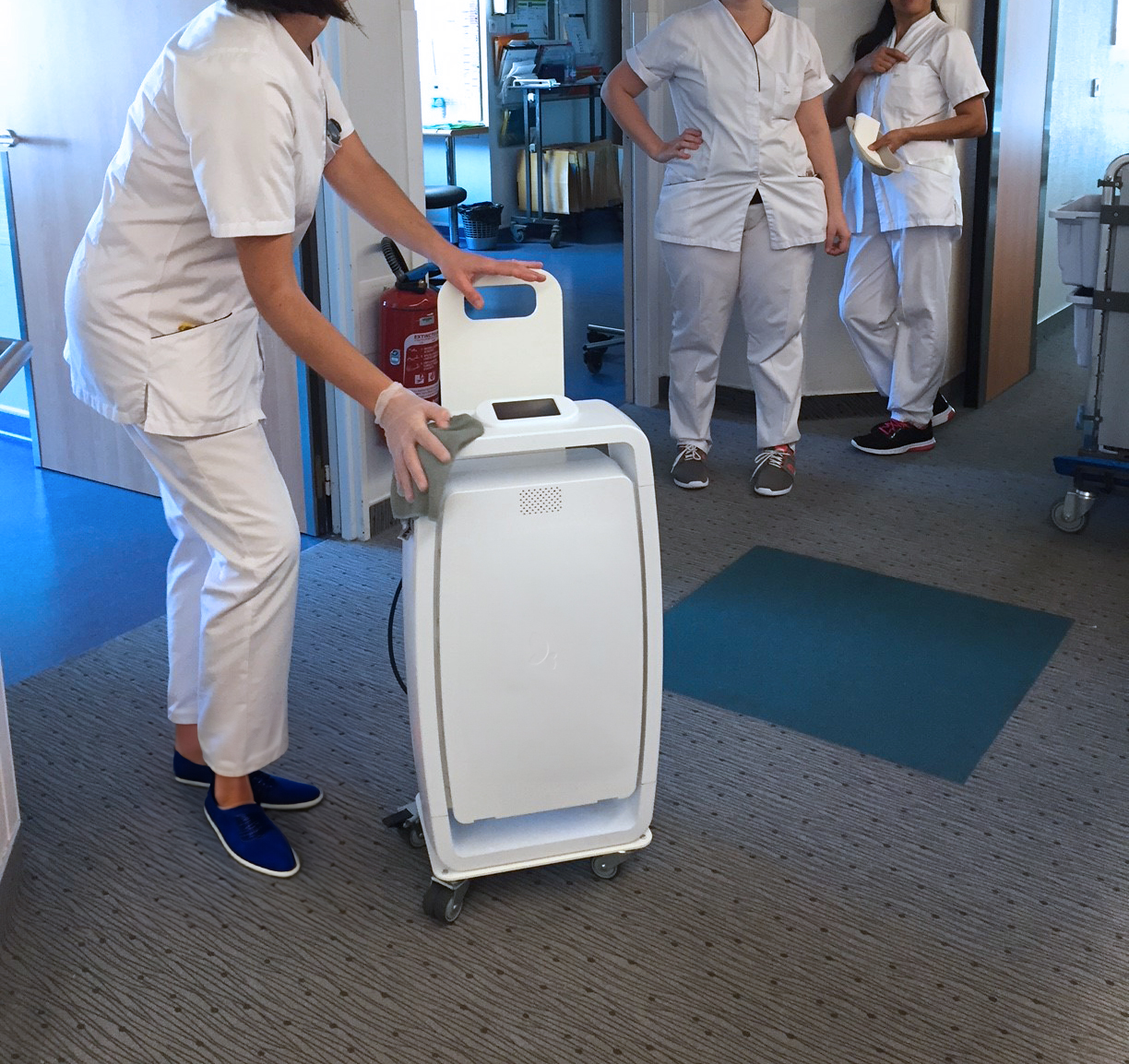
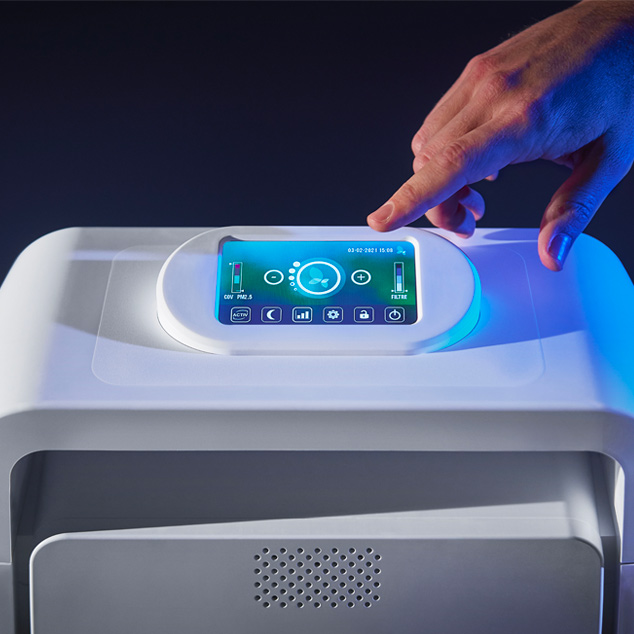
Air Coach monitors the airborne health risk at your facility in real time
A respiratory virus spreading through the community, a spike in CO₂ levels indicating poor air circulation in a crowded waiting room, or formaldehyde exposure exceeding the INRS threshold in a pathology lab: these events occur silently. Air Coach detects them as they happen.
Connected sensors are deployed in your high-risk areas. They continuously measure critical air quality parameters and transmit data to a centralized console accessible to your technical department, your hospital hygiene team, and NatéoSanté.
- CO2: Ventilation and Viral Risk Index
- PM1 / PM2.5 / PM10: viral aerosols and fine particles
- VOCs: disinfectants, glutaraldehyde, anesthetics
- Formaldehyde: histopathology, microbiology, aseptic technique
Configurable alarm thresholds by zone, acknowledgable alerts, real-time comparison of indoor and outdoor air quality via Open-Meteo and CAMS, and consolidated monitoring of multiple facilities from a single dashboard.
Air Coach doesn't replace your sanitation unit. It equips it with a sentinel that never sleeps.
Your indoor air quality data, monitored by the NatéoSanté teams
Air Coach does more than just take measurements. Your sensors continuously transmit data to our monitoring center in Saint-Hilaire-de-Chaléons, where our teams monitor, assess, and resolve alerts on behalf of your facilities.
A dedicated team behind every alert
Your Air Coach sensors send their data to our secure infrastructure every minute. On a wall of screens, our operators monitor indoor air quality across all client facilities: multi-site mapping, trend graphs, and prioritized alerts.
When an anomaly is detected, it is never considered in isolation. Our teams cross-reference it with contextual data (CAMS outdoor pollution data, Open-Meteo weather data, and site history) before triggering an alert to your designated contact. You receive only verified and actionable notifications.
What you get: the peace of mind that comes with a managed service, backed by a team of indoor air quality experts who are on the job 24/7—even when your in-house technical team can’t be.
- 24/7 monitoring: operator on-call during business hours, automated monitoring with escalation outside of business hours, and human intervention for any critical alerts.
- Qualified alerts: filtering out false positives, contextualization with outdoor air, prioritization based on zone criticality and pathogen type.
- Automated reports: monthly, quarterly, and annual. PDF and CSV exports. Integration with QSE, CSR, and hospital hygiene committees.
Start your assessment
Entrust the air quality at your sites to NatéoSanté
A managed service model—you're in control
You retain control over strategic decisions. We handle the five steps: assessment, deployment, 24/7 monitoring, alerts, and regular reports. Your IT department is relieved of operational management responsibilities.
- Indoor Air Quality (IAQ) Assessment: Remote assessment, without entering your facility. We ship an Air Coach sensor; you simply plug it in. Multi-parameter measurement: CO₂, PM1, PM2.5, PM10, VOCs, formaldehyde, temperature, humidity. Variations, timestamps, peaks. Analysis by our experts and comparison to regulatory standards (IAQ Decree for Public Buildings, Labor Code, INRS Occupational Exposure Limits, WHO recommendations). Making the invisible visible to make the right decisions and control the healthcare environment. Detailed diagnostic report with technical and budgetary recommendations.
- Deployment: Installation of Eolis Air Managers and Air Coach sensors calibrated according to the recommendations of the diagnostic report. Commissioning, threshold configuration, and training for your technical staff.
- 24/7 Monitoring: Your equipment is continuously monitored from our secure platform. Automatic detection of deviations, monitoring of filter wear, and tracking of fleet availability.
- Real-time alerts: email, SMS, or push notifications sent to your designated contacts when thresholds are exceeded. Criticality level, affected area, and recommended action. Traceable acknowledgment for your audits.
- Periodic reports: monthly reports by region, quarterly consolidated reports across multiple sites, and an annual report that can be incorporated into the DUERP. Compliance with the QAI ERP decree, QSE and CSR indicators, and PDF and CSV exports.
NatéoSanté: Fifteen Years of Expertise in the Hospital Setting
NatéoSanté been recognized by French Healthcare as a key player in the national fight against COVID-19 and supplies hospitals in more than 60 countries. Eolis Air Manager is the only air purifier verified under the European Commission’s ETV (Environmental Technology Verification) program, with support from ADEME.
- 2009: Establishment and development of our French laboratory.
- 100% French: design and manufacturing have been brought back to France since 2016.
- 60+ Countries: Healthcare facilities equipped worldwide (Europe, China, etc.).
- Recognition: Listed by French Healthcare as part of the national COVID-19 response, supported by ADEME, and certified as compliant with NF B44-200 and NF EN 16846-1 standards.
Six sensitive areas in hospitals, a well-managed air quality strategy
The waiting room: 50 square meters, 20 to 40 people per hour
Without air purification, CO₂ levels regularly reach 1,800 ppm during the winter months, indicating insufficient air exchange and an increased risk of viral transmission.
Solution: Eolis Air Manager 600S, CO₂ levels reduced to below 1,000 ppm, continuous monitoring.
Technical Services and Medical Waste Facility: Areas with High Biological Load
Storage areas for infectious medical waste accumulate bioaerosols and odors. Risk of exposure for logistics staff.
Solution: Eolis 1200S, high-concentration ozone cycle in unoccupied rooms for air and surface decontamination, presence mode during the day.
The recovery room: residual anesthetic gases and vulnerable patients
The removal of residual gases by mechanical ventilation is only partial. The air must also be free of biological contaminants for immunocompromised post-operative patients.
Solution: Eolis H14 + high-concentration ozone cycle between patients for rapid decontamination, allowing the room to be ready for use again in less than an hour.
The Pathology and Microbiology Laboratory: Formaldehyde and Solvents
Pathology laboratories remain exposed to formaldehyde despite the use of alternatives, and microbiology areas require strict control of VOCs.
Solution: Eolis 1200S Perform+, dedicated formaldehyde Air Coach, INRS threshold alarm.
The geriatric unit and the adjacent nursing home: BHRe and winter viruses
A vulnerable population, continuous occupancy, and significant interaction between caregivers, visitors, and residents. This creates an ideal environment for respiratory viruses.
Solution: Eolis 600S system installed in each room and living area, set to continuous operation mode plus a high-concentration cycle for room decontamination after a resident leaves.
Overall Management: QSE and Hygiene Dashboard
Your QSE, CSR, and hospital hygiene reports require traceable data. NatéoSanté generates NatéoSanté for you, by area and by site.
Solution: NatéoSanté Platform, with automatic monthly and quarterly exports.
Eolis Air Manager deployed in your healthcare settings
- Patient room: hotel-style comfort, medical safety. The Eolis PM wall-mounted unit is quiet and seamlessly integrated into the design of private clinics and university hospitals.
- Neonatology, NICU: the most vulnerable areas, maximum protection. Eolis PM in neonatal intensive care units, protecting newborns and immunocompromised patients.
- Laboratory, Pathology: Chemical pollutants under control. Eolis 1200S Perform+ in pathology and microbiology laboratories, monitoring formaldehyde and VOCs.
Frequently Asked Questions: Indoor Air Quality in Hospitals and Clinics
What is the best air purifier for a hospital or clinic?
How can we effectively reduce the risk of airborne hospital-acquired infections?
Does an air purifier protect against hantavirus?
Is the ozone released by the Eolis Air Manager dangerous?
Which air quality parameters should be continuously monitored in a hospital?

101 Gustave Eiffel Street
44680 SAINT-HILAIRE-DE-CHALEONS
France
Hours
Monday through Friday
9:00 AM – 1:00 PM
2:00 PM – 5:00 PM