
A preprint research paper, published on October 6, 2020, under the original title “Testing mobile air purifiers in a school classroom: Reducing the airborne transmission risk for SARS-CoV-2,” details a recent experiment conducted by Professor Joachim Curtius at Goethe University (Institute for Atmospheric and Environmental Sciences) in Frankfurt.
Four air purifiers available on the market, equipped with medical-grade HEPA filters, similar to those found in the EOLIS Air Manager from NatéoSanté, were tested for one week in a school classroom normally occupied by students. A classroom without any devices served as a control.
After 30 minutes, 90% of the aerosols present in the indoor air of the occupied room had been removed, while the level of fine particles PM10 had also decreased significantly.
These findings should be considered in light of the potential risk of COVID-19 transmission via these aerosols, in addition to droplets and fomites (contaminated objects). This is especially true in crowded, enclosed spaces, such as classrooms, as well as business premises, multi-station and enclosed offices, open-plan offices, retail stores, and all public venues such as hotels, restaurants, gyms, etc. This comes as the Auvergne-Rhône-Alpes Region has just announced the installation of air purifiers in the 565 high schools under its jurisdiction.
- Read more on this topic: “Businesses: Why Invest in a Professional Air Purifier?”
Even though adhering to social distancing and preventive measures—starting with opening windows at regular intervals to ventilate the space—are the primary precautions to take to protect yourself and others during this period of heightened risk of a second wave of the pandemic.
The four air purifiers tested were equipped with HEPA 13 filters
“Airborne transmission of SARS-CoV-2 via virus-containing aerosols has been established as a route of COVID-19 infection,” states the abstract of the study conducted by Professor Joachim Curtius and his team.
- Read more on this topic: “U.S. health authorities now consider aerosols to be a possible mode of transmission for the virus”
Regarding the methodology:
“We tested the effectiveness and feasibility of operating four air purifiers equipped with HEPA 13 filters in a high school classroom while regular classes were in session.
We monitored:
- The aerosol concentration for particles larger than 3 nm at two locations in the room
- The size distribution of aerosols in the range from 10 nm to 10 μm
- PM10 and CO2 concentrations
"For comparison, we took similar measurements in a nearby classroom without an air purifier. "
Aerosol concentrations were reduced by more than 90% in 30 minutes in the classroom equipped with air purifiers
Regarding the measurements taken and the conclusions drawn:
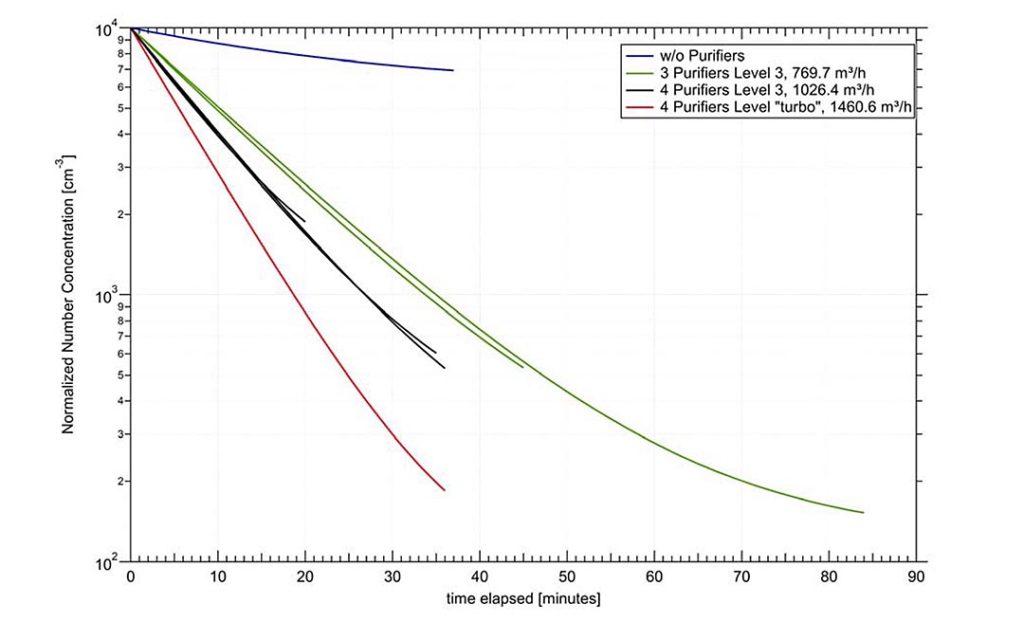 “Reduction in aerosol particle concentration in a closed classroom without air purifiers (blue line)
, and with 3 or 4 air purifiers operating at stage 3 (3 × 257 m³/h per air purifier, green lines;
4 × 257 m³/h per air purifier, black lines) or stage “turbo” (4 × 365 m³/h, red line).
Data are normalized to a starting value of 10,000 particles/cm³. Data are displayed for the time intervals
until doors or windows were opened again.
"When classes were held with the windows and door closed, aerosol concentrations were reduced by more than 90% in less than 30 minutes while the air purifiers were running (air exchange rate of 5.5 h⁻¹)."
The reduction was uniform throughout the entire sample and across all particle sizes.
The measurements were supplemented by a calculation estimating the maximum concentration levels of virus-containing aerosols emitted by a highly contagious person speaking in a closed room, both with and without air purifiers.
Measurements and calculations show that air purifiers are effective at significantly reducing the risk of airborne transmission of SARS-CoV-2.
"Based on a two-hour stay in a closed room with a highly infectious person, we estimate that the inhaled dose is reduced by a factor of six when using air purifiers with a total air exchange rate of 5.7 h⁻¹."
Learn more about
, the professional air purifier
eolis air manager