
An air purifier is a device that removes pollutants from the air (pollen, pet dander, dust mites, viruses, bacteria, VOCs, dust, etc.).
There are different types of air purifiers: "active" air purifiers and "passive" air purifiers.
• Active air purifiers:
Using a fan, the air purifier draws air from the room into the unit. The air drawn in passes through various filters and is then released back into the room, purified.
To capture physical particles, an air purifier must have a filtration system. It is important to consider the quality of the filters. Indeed, the higher the quality of the filters, the more particles they capture.
All NatéoSanté air purifiersare equipped with filters.
For example, the diagram below shows the filtration system of theEOLIS Air Manager air purifier:
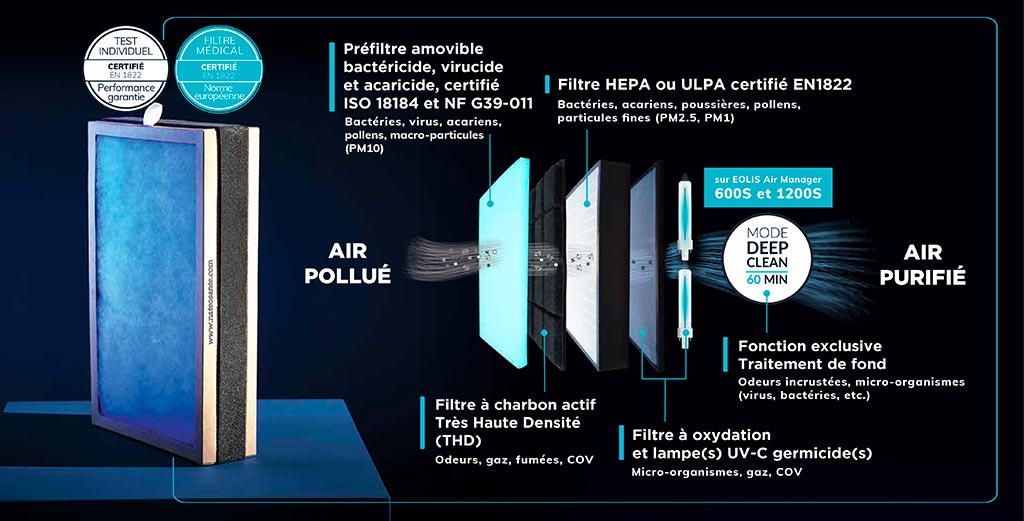
Step 1: Air filtration via the pre-filter
Placed directly on the filter cover, this water-washable foam filter acts as soon as air enters the unit.
It traps large particles—such as coarse dust and pet hair—and helps extend the life of the filtration system. Clean regularly.
Step 2: Air filtration using activated carbon
High-density activated carbon beads filter and remove toxic gases, such as formaldehyde, benzene, hydrogen sulfide, ammonia and bleach fumes, unpleasant odors, and many others… The high concentration of activated carbon in NatéoSanté air purifiers also NatéoSanté the rapid breakdown of ozone present in your indoor air.
Step 3: Air filtration via the HEPA filter
It traps airborne particles.
The HEPA (High Efficiency Particulate Air) filter is a medical-grade filter, also known as an absolute filter. We have chosen to offer you the highest HEPA classification: H14. Compliant with EN1822, it removes 99.99% of particles as small as 0.3µm.
Thanks to its tight weave and precise fiber arrangement, this filter traps: fine dust, dust mites, pollen, pet dander, diesel particles, mold, spores, fungi, pesticides, bacteria, viruses, and microorganisms.
Features that can be enabled or disabled depending on your preferences and specific needs:
Step 4: Air filtration using the
oxidation filter Oxidation filter: a filter containing titanium dioxide and a UV-C lamp. This process harnesses and concentrates the energy from the UV-C lamp to destroy microorganisms and convert VOCs (volatile organic compounds) into H₂O and CO₂.
Step 5: UV-C Lamp Disinfection (ON/OFF)
The UV-C (Ultraviolet) lamp in the air purifiers kills more than 97.6% of airborne germs and bacteria.
Step 6: Negative Ion Generation (ON/OFF)
Over 8 million ions are released per second. These anions help restore balance to your environment.
Step 7: Active Oxygen Generator (ON/OFF)
This active oxygen feature thoroughly cleans your room while you’re away. Active oxygen effectively eliminates unpleasant odors (such as tobacco, cooking, pet, and body odors), dust mites, mold, and more…
• So-called "passive" air purifiers
A so-called "passive" air purifier filters the air in the immediate vicinity of the unit. On average, these types of air purifiers have an airflow rate of 14 m³/h, which corresponds to the average speed at which air moves naturally. A “passive” air purifier does not have a filtration system; they are generally simple air ionizers.
You might also be interested in

What is an air purifier? Tips for choosing an air purifier, effects on the respiratory system
Indoor air purifiers (or air filters) filter the air in enclosed spaces and release purified air. Depending on their technical design and key features, they are intended either for the general public or for professional use.
For Professionals: Manage the indoor air quality in your facilities with the NatéoSanté monitoring system
Whether it’s about providing clean air for customers, patients, students, and the general public, or creating a pleasant work environment for staff, indoor air quality (IAQ) affects everyone and every profession. The health crisis that began in March, as a result of the COVID-19 pandemic, has further heightened this concern, […]

Why measure CO2? What are dangerous CO2 levels in ppm? What is the maximum CO2 level in a room or in the air?
CO2 emissions into the atmosphere pose a major threat to the planet’s ecological balance, but excessive indoor exposure can also pose risks to human health. High CO2 concentrations can lead to symptoms such as headaches, fatigue, reduced concentration and cognitive function, and an increased incidence of respiratory infections.
How can you protect yourself against airborne transmission of the COVID-19 virus?
In a statement published on July 13, 2020, on the United Nations website, the World Health Organization (WHO) confirmed “the risk of airborne transmission of the virus.” This announcement came after 200 scientists sounded the alarm. “We acknowledge that evidence is emerging in this area, as in other areas […]