
Why measure CO2? What are dangerous CO2 levels in ppm? What is the maximum CO2 level in a room or in the air?
What is CO2?
Where does carbon dioxide come from?
Carbon dioxide (CO2), also known as “carbon dioxide” or “carbonic acid anhydride,” is a gas that occurs naturally in the atmosphere and plays a crucial role in the carbon cycle.
It is produced by biological processes, such as the respiration of living organisms and the decomposition of organic matter, as well as by human activities such as the burning of fossil fuels.
The difference between carbon monoxide and carbon dioxide
It is essential not to confuse carbon monoxide (CO) with carbon dioxide (CO2).
CO is a toxic, odorless, and colorless gas produced by the incomplete combustion of fossil fuels; it can be fatal if there is prolonged exposure in poorly ventilated areas.
In contrast, CO₂ is a natural component of the atmosphere.
The Link Between CO2 and Our Health
CO2 emissions into the atmosphere pose a major threat to the balance of our planet, but excessive indoor exposure can also pose risks to human health.
High CO2 concentrations can lead to symptoms such as headaches, fatigue, reduced concentration and cognitive function, and an increased incidence of respiratory infections.
Currently, there is no technological solution for removing CO2 from a room, with the exception of certain industrial applications.
Ventilation (air exchange) remains the only effective method for bringing CO2 levels back down to an acceptable level.
However, it is crucial to know when CO2 levels become too high. As an invisible and odorless molecule, CO2 can only be detected and measured using specific sensors.
The image above illustrates carbon dioxide (CO2) concentration levels in the air, measured in parts per million (ppm), and their impact on indoor air quality.
It also specifies the CO2 threshold at which it becomes essential to ventilate the room.
At concentrations of 400 ppm, outdoor air is considered excellent. When CO2 levels reach 600 ppm, air quality is still good.
However, between 600 and 1,000 ppm, air quality becomes moderate, indicating that it is time to ventilate your indoor spaces to maintain a healthy environment.
The maximum CO2 level in a room is 1,000 ppm; at this level, air quality is considered poor, and above 2,000 ppm, it is critical and poses a health risk.
These recommendations, issued by the High Council for Public Health, emphasize the importance of proper ventilation and adequate air circulation to prevent the harmful effects of CO2 on health.
Using CO2 sensors makes it possible to monitor these levels and take appropriate action to ensure good indoor air quality.
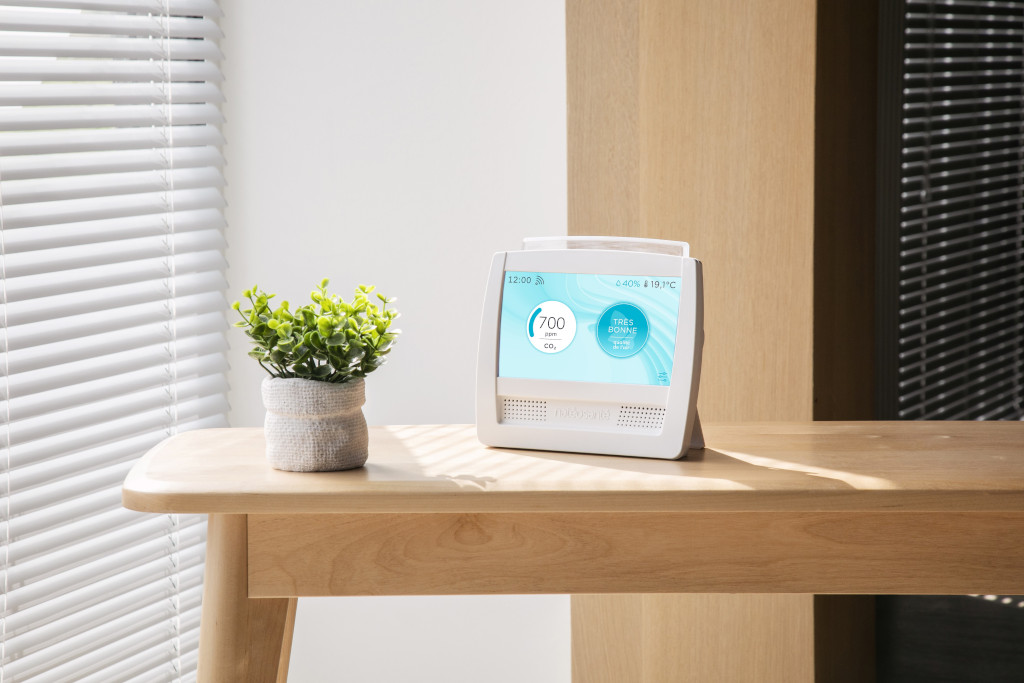
Air Coach: NatéoSanté innovative solution NatéoSanté monitoring indoor air quality
NatéoSanté developed Air Coach, an indoor air quality monitor that measures carbon dioxide (CO2) levels in real time.
Equipped with NDIR infrared sensors—recognized as the most reliable on the market—Air Coach becomes an indispensable tool for taking appropriate action when safety thresholds are exceeded.
This CO2 monitor is invaluable in a variety of settings: at home, in the office, at school, in daycare centers, and in public buildings.
It is particularly useful in schools and daycare centers, where a regulation requires real-time monitoring of CO2 levels and the installation of ventilation indicators to optimize ventilation practices.
Why measure CO₂? Breathe clean air with Air Coach
Indoor air quality plays a vital role in our well-being and health.
Yet we spend nearly 90% of our time indoors, where the air can be up to five times more polluted than outdoors.
Among the many invisible pollutants, carbon dioxide (CO₂) is a key indicator of air renewal and the need to ventilate or purify a space.
With Air Coach, NatéoSanté helps NatéoSanté analyze and improve your indoor air in a simple and educational way.
CO₂: Why Measure It?
CO₂ is naturally present in the air, but its concentration rises rapidly in an enclosed space due to human respiration.
High CO₂ levels can lead to:
- fatigue and headaches
- decreased concentration and drowsiness
- poor oxygenation of the brain
- a feeling of discomfort and stuffiness
Measuring CO₂ levels helps you determine when it’s time to ventilate and take the right steps to ensure good indoor air quality.
What are the CO₂ limits that should not be exceeded?
The CO₂ level is expressed in ppm (parts per million) and provides a direct indication of the quality of air exchange.
| CO₂ concentration (ppm) | Air quality | Recommended Actions |
|---|---|---|
| 400–600 ppm | Outdoor air | Perfect—no action required |
| 600–800 ppm | Good quality | Keep an eye on developments |
| 800–1,000 ppm | Average quality | Open the window slightly |
| 1,000–1,500 ppm | Poor quality | Open the window wide to let in some fresh air |
| > 1,500 ppm | Stale air | Health risks—proper ventilation is essential! |
When should you open or close the window? Air Coach is here to help!
With Air Coach, you no longer have to guess when and how to ventilate.
This smart sensor provides real-time recommendations and guides you through best practices:
- Open the window slightly when a light air change is needed (800–1,000 ppm).
- open wide to allow for rapid air exchange as soon as the critical threshold is reached (> 1,200 ppm).
- Close the window if the outside air is more polluted or if the outside temperature is too low.
- predict air quality before it deteriorates, using the Air Coach’s CO₂ forecasts.
Is an air filtration system necessary?
If natural ventilation is not sufficient to ensure acceptable air quality, it may be necessary to install an air purification and filtration system.
Our NatéoSanté professional air purifiers help NatéoSanté :
- reduce CO₂ levels and refresh the air in addition to natural ventilation
- remove fine particles, viruses, and allergens
- improve comfort and concentration in enclosed spaces
During the COVID-19 pandemic, a CO2 sensor is also a good way to remind yourself to ventilate regularly
“CO₂ is a gas exhaled during human respiration,” explains the daily newspaper Le Monde in an article dated October 16, 2020.
“Changes in the concentration of this gas therefore make it possible to measure the effect of mechanical or manual ventilation caused by opening doors and windows, just as they indicate the presence of people in the room.”
“As soon as you install a sensor in a room that measures CO2 levels, it triggers a reflex to ventilate,” explains Benoit Semin, a researcher at the CNRS, in the same publication.
While this is a common-sense reflex, there is not yet a scientifically determined alert threshold to correlate CO2 levels with an increased potential risk of COVID-19 transmission via indoor air spread.
“It is currently impossible to answer this question, as no one knows what viral load is infectious, let alone what concentration in the air would pose a risk,” writes Le Monde.
In the meantime, it is advisable to continue monitoring and maintaining CO2 levels at an acceptable threshold and to ventilate the space when that level is exceeded.
What role does CO2 play in outdoor air pollution?
Although CO2 occurs naturally, it is accumulating at excessive levels in the atmosphere due to human activities, thereby exacerbating global warming and ocean acidification.
In its latest report, the IPCC emphasizes that human activities have caused unprecedented global warming, resulting in a 1.1°C increase in the Earth’s average surface temperature compared to pre-industrial levels.
Regardless of the emissions scenario considered, the IPCC predicts that global warming will reach 1.5°C by the early 2030s.
To limit global warming to 1.5°C or 2°C, it is imperative to immediately accelerate and intensify efforts to reduce emissions by:
- reducing global net CO2 emissions to zero
- drastically reducing other greenhouse gases
Solutions are being considered with the aim of mitigating the impacts of these emissions:
- the reduction in consumption and the use of fossil fuels
- the production and use of carbon-free energy
- energy-efficient renovation and passive house construction
- the use of green and sustainable transportation
- reducing waste and pollution
- promoting agroecology, tree planting, and water reuse
At the same time, new technologies are emerging with the aim of reducing or eliminating CO2 at the source.
There are currently two methods:
- Carbon capture and storage (CCS): a process for capturing carbon emitted from the combustion of fossil fuels at the point of release from industrial facilities.
It is worth noting that in Europe, the CASTOR project, launched in 2004, was already aimed at developing CO2 capture technologies.
Currently, approximately thirty facilities are operational worldwide, primarily in the United States, capturing 40 million tons of CO2 per year.
According to the International Energy Agency’s (IEA) Net Zero Emission by 2050 scenario, the goal is to capture 7.6 gigatons of CO2 annually by 2050, thanks to technological advances in the field of carbon capture. - Direct air capture (DAC): a method for extracting CO₂ from the air using ventilation systems and chemical processes.
However, this technique is more complex due to its high energy consumption and cost.
All of this research represents a significant financial investment, in addition to requiring high energy consumption.
At the same time, questions regarding the storage and reuse of this carbon dioxide remain unresolved.
You might also be interested in

What is an air purifier? Tips for choosing an air purifier, effects on the respiratory system
Indoor air purifiers (or air filters) filter the air in enclosed spaces and release purified air. Depending on their technical design and key features, they are intended either for the general public or for professional use.
How can you protect yourself against airborne transmission of the COVID-19 virus?
In a statement published on July 13, 2020, on the United Nations website, the World Health Organization (WHO) confirmed “the risk of airborne transmission of the virus.” This announcement came after 200 scientists sounded the alarm. “We acknowledge that evidence is emerging in this area, as in other areas […]

Pollen Allergies: Symptoms, Seasonal Patterns, and Tips for Breathing Easier
By 2026, nearly one in five French people will suffer from pollen allergies. Symptoms, the pollen season, treatments, and daily habits: everything you need to know to minimize the impact of seasonal respiratory allergies.
Monitoring Indoor Air Quality in Childcare Facilities
The new regulatory framework for monitoring indoor air quality in public buildings has been in effect since January 1, 2018, in daycare centers and schools. NatéoSanté, a specialist in air quality, offers to assist public-access facilities (ERP) throughout the process of implementing the monitoring system for […]