
Two recent scientific studies have brought pollen and PM2.5 fine particles into the debate on possible factors accelerating SARS-CoV-2 transmission and the spread of COVID-19. This serves as a reminder that, even beyond the pandemic, air pollution—both outdoor and indoor—remains one of the leading causes of death worldwide.
As a result of widespread lockdowns around the world, the general slowdown in economic activity, and reduced population mobility, 84% of countries saw a decrease in PM2.5 air pollution levels in 2020. This is the finding of a study published on February 18 by IQAir in partnership with Greenpeace.
But of the 106 countries surveyed, based on data from ground-based monitoring stations, only 24 met WHO air quality standards. In a recent op-ed published in the press under the title “Relying on the Market to Combat Air Pollution, ” economists Stefan Ambec and Claude Crampes remind us, if any reminder were needed, that “fine particulate matter, nitrogen oxide, sulfur dioxide, and volatile organic compounds (…) are poisoning the air we breathe.”
“In France,” they continue, “that amounts to 48,000 premature deaths per year—9% of annual mortality—and up to two years lost in life expectancy. These figures are comparable to those for COVID-19 in 2020 (54,000 deaths according to INSEE). Globally, that amounts to 4.2 million deaths per year.”
Outdoor and indoor air pollution ranks as the fourth leading cause of death worldwide
The most recent statistics, available on the authoritative website Our World In Data, indicate 4.9 million deaths (2017) due to combined indoor and outdoor air pollution, ranking as the fourth leading cause of death. This figure may be an underestimate: “Harvard researchers, meanwhile, arrive at a total of 8.7 million premature deaths based on 2018 data. That is one in five deaths worldwide. (…) China continues to bear the heaviest toll, with 2.4 million victims.” (source: Le Monde, February 9, 2021).
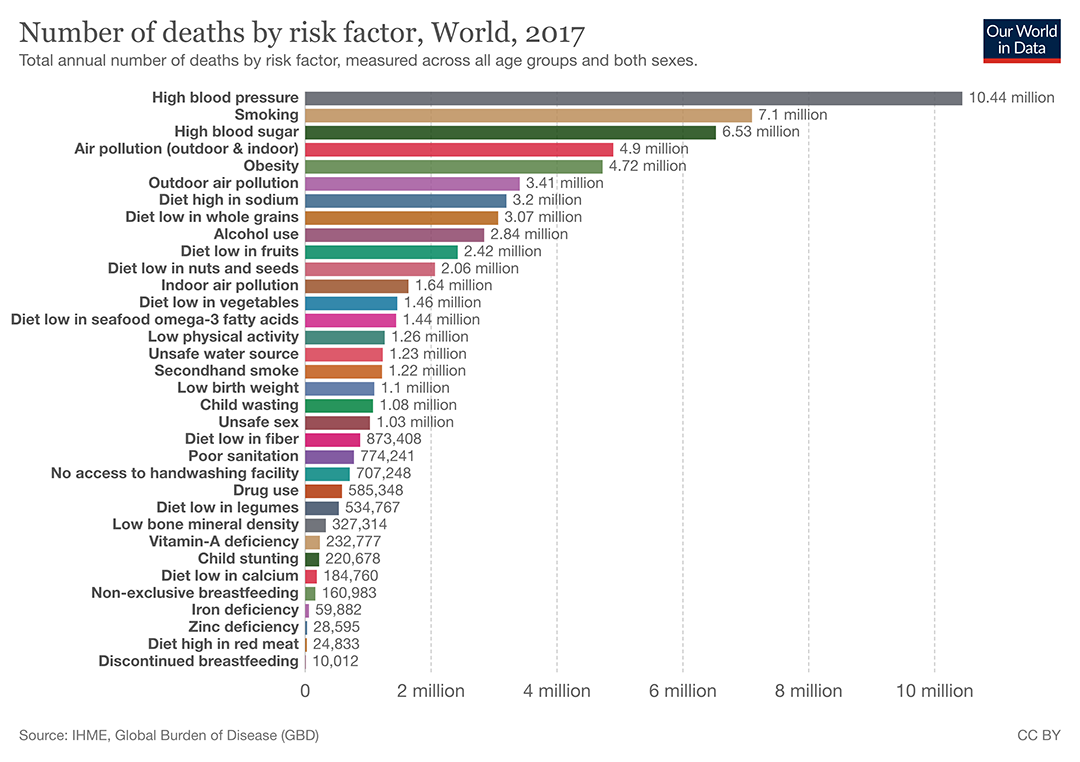 Source: Our World in Data
In mid-April 2021, to round out this overview of the situation, Santé Publique France updated its estimates for the period from 2016 to 2019, bringing them in line with the figures above: the agency estimates that “mortality linked to ambient air pollution remains a significant risk in France, with 40,000 deaths attributable each year to PM2.5 fine particulate matter.”
COVID-19: Does Pollen Spread the Virus Faster?
In this context, two studies have been published in recent weeks linking COVID-19 to changes in air quality. The first concerns the impact of pollen. The second concerns the impact of PM2.5 fine particulate matter.
In a study titled “Higher airborne pollen concentrations correlated with increased SARS-CoV-2 infection rates, as evidenced from 31 countries across the globe,” a team of biologists from the Technical University of Munich began with the following premise: “Exposure to airborne pollen increases susceptibility to respiratory viral infections, regardless of allergic status.”
We hypothesized that this might also be true for SARS-CoV-2 infections. To investigate this, we examined the relationships between SARS-CoV-2 infection rates and pollen concentrations, as well as humidity, temperature, population density, and the effects of lockdowns. Our dataset comes from 130 sites in 31 countries across five continents.
 Source: PNAS
The researchers’ conclusion: “Our results show that simultaneous exposure to SARS-CoV-2 (via other infected human carriers) and airborne pollen can, under specific weather conditions, promote viral infection. " In figures: an increase of 100 pollen particles per cubic meter would correspond to a 4% higher infection rate.
Since correlation does not imply causation, they emphasize that these findings should be interpreted with caution so as not to alarm the general public. At the same time, they note that for those most at risk of respiratory issues, wearing a mask—a protective measure that has become standard practice during the COVID-19 pandemic—remains a wise precaution should a pollen surge occur:
- In the spring, from mid-March to mid-June, this is mainly due to birches, maples, and poplars;
- Once summer arrives, from late May through October, a wide variety of grasses take center stage.
“Patients with allergies have the same risk of contracting COVID-19 as those without allergies,” clarifies Prof. Laurent Guilleminault, a pulmonologist and allergist at Toulouse University Hospital, in an interview with La Dépêche. “The German study is interesting because it raises the question of the direct role of pollen. Indeed, these are enzymes that can break down the lining covering the bronchi or the nose… which could make it easier for the virus to enter. For now, there is no proof. Just an observation that during pollen peaks, there are more cases of COVID-19.”
This brings us back to the important distinction between correlation and causation: just because two variables change at the same time doesn’t necessarily mean that one is the cause of the other.
The causal link between PM2.5 fine particulate matter and SARS-CoV-2 syndrome has yet to be established
The second study, which was widely reported by the media in early March 2021, examines the possible link between PM2.5 fine particulate matter and COVID-19 infections.“It is possible that air pollution from fine particulate matter is responsible for exacerbating the epidemic, both in terms of the number of new infections and hospitalizations for Covid-19,” noted Antoine Flahaut, professor of public health and director of the Institute of Global Health (University of Geneva), while several French regions (Corsica, Hauts-de-France, Grand-Est, Nouvelle-Aquitaine, Île-de-France) had just been hit by successive episodes of sandstorms originating in the Sahara.
The scientist is the co-author of a research paper published in November 2020 on this topic: “Peaks of Fine Particulate Matter May Modulate the Spread and Virulence of COVID-19.”
The abstract outlines the scope of the study: “We examine the potential links between spikes in fine particulate matter (PM2.5) levels and the sudden, sharp increase in hospitalizations and mortality rates in the Swiss canton of Ticino, as well as in the Greater Paris and London regions (Editor’s note: in March 2020).”
 Source: Abstract of the study “Peaks of Fine Particulate Matter May Modulate the Spread and Virulence of COVID-19”
We argue that these spikes in fine particulate matter occur primarily during temperature inversions in the atmospheric boundary layer. We also discuss the influence of Saharan dust intrusions on the COVID-19 outbreak observed in early 2020 in the Canary Islands. We consider it both reasonable and plausible that high concentrations of PM2.5—driven by air temperature inversions or Saharan dust intrusions—not only modulate but further exacerbate severe COVID-19 outbreaks.
We conclude that the strain on healthcare systems and hospitals, as well as the high excess mortality observed in various regions of Europe in the spring of 2020, may be linked to spikes in PM2.5 levels and likely specific weather conditions that facilitated the spread of the virus and increased its virulence. “In the future, we recommend not only monitoring the prevalence of the virus but also taking into account the occurrence of weather conditions that could lead to sudden and highly explosive outbreaks of COVID-19.”
These remarks are echoed in the subsequent work by radiologist Thomas Bourdrel and his co-authors, published in February 2021 (European RespiratoryJournal ).
“ “The specific links between air pollution and SARS-CoV-2 infection remain unclear,” they summarize . “Here, we provide evidence from in vitro, animal, and human studies based on the existing literature. Epidemiological studies have linked various air pollutants to COVID-19 morbidity and mortality at the population level, but these studies have several limitations.”
Air pollution may be a factor contributing to the increased severity and mortality of COVID-19 due to its impact on chronic conditions, such as cardiovascular and pulmonary diseases and diabetes. Experimental studies have shown that exposure to air pollution leads to a weakened immune response, thereby facilitating viral entry and replication.
Viruses can remain airborne through complex interactions with particles and gases depending on:
1) DChemical composition
2) Electric Electric charges of particles
3) Dweather conditions such as relative humidity, ultraviolet (UV) radiation, and temperature.
"Furthermore, by reducing UV radiation, air pollutants can promote the persistence of viruses in the air and reduce vitamin D synthesis."
Sustainable development and clean air go hand in hand
In practical terms, what are the consequences—or even the precautions—to take… given that the policy of a third lockdown in France, in effect since mid-March 2021, has encouraged the French to go outside, and that the fine spring weather—often high-pressure and accompanied by light winds—is a factor contributing to the deterioration of air quality: emissions of fine particulate matter from road traffic, as well as those from home heating and, unfortunately, many other man-made sources… dissipating more slowly.
“Air pollution facilitates viral infections and, consequently, the spread of viruses,” explainsLaurent Plantier, a pulmonologist at the Tours University Hospital, in an interview with Ouest-France. “Tissues are covered by what is known as an epithelium, a layer of cells. This layer is coated with mucus, which acts as a barrier against pathogens (diseases)… When the epithelium is damaged for one reason or another, the initial damage facilitates further damage. (…) Allergens therefore pass through the protective barrier and trigger symptoms.” As for going so far as to say that PM2.5 fine particles and COVID-19 are linked, the question remains open for the physician…
One thing is certain, however, in these troubled times… the importance of good air quality for everyone—and, by extension, the need for sustainable development to protect our climate—is more pressing than ever and is now on everyone’s mind.
In addition: the ATMO index, which has been revised since early 2021
Whether by chance or coincidence, the ATMO air quality index, created in 1994, was updated on January 1, 2021, to include a new pollutant in its calculations—namely, PM2.5 fine particulate matter. They join sulfur dioxide (SO2), nitrogen dioxide (NO2), ozone (O3), and PM10 fine particulate matter.
The daily rating consists of six levels, ranging from good to extremely poor. It is calculated for a 24-hour period, starting at 00:00 UTC, at the municipal level and, at most, at the inter-municipal level. The final index is based on the lowest sub-index for each of the five components.
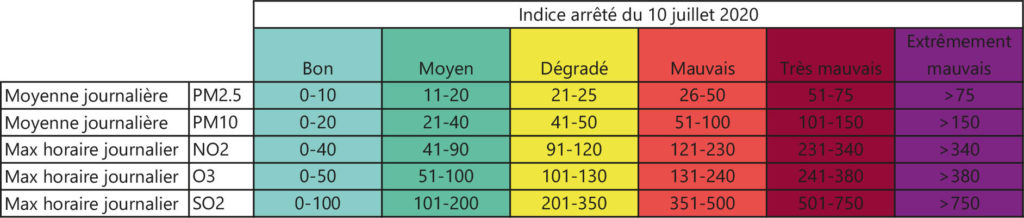 Source: ATMO-FRANCE
The latest version of the decree (December 14, 2020) establishing the calculation methods defines the index as“a simplified representation of background air quality, i.e., away from specific sources of pollution such as major roadways.” Finally, ATMO 2021 is no longer limited to the monitoring station. “It provides information on an entire territory through modeling and a spatial aggregation method, ” introducing the concept of representativeness of the geographic area.
You can find the air quality index for your area and the forecast by visiting the dedicated website. The data is also available as open data, broken down by region.
You might also be interested in

Air Quality and Athletic Performance: What We Can Learn from Elite Athletes
Olympic sailing champions have tested it: air quality directly affects performance. And this applies to you, too. Find out how.
Improving indoor air quality in elementary, middle, and high schools using CO2 sensors and air purifiers
With its comprehensive range of services, NatéoSanté supports NatéoSanté in implementing solutions that not only help you comply with regulations regarding indoor air quality (IAQ) monitoring in public buildings but also effectively combat the spread of the coronavirus responsible for COVID-19. Ensure purified air and protection […]
Indoor Air Quality in 2026: Health, Environment, and Regulations—Where Do We Stand?
European Directive 2024/2881, IAQ requirements in public buildings starting in 2025: What is the state of indoor air quality in France in 2026, and what measures should be taken?
Pollen Allergies: Symptoms, Seasonal Patterns, and Tips for Breathing Easier
By 2026, nearly one in five French people will suffer from pollen allergies. Symptoms, the pollen season, treatments, and daily habits: everything you need to know to minimize the impact of seasonal respiratory allergies.