
Monitoring Indoor Air Quality in Public Buildings: What Are the Requirements for Schools and Daycare Centers?
As of January 1, 2023, the program is no longer based on a series of measurements taken at fixed intervals. It provides for more regular monitoring of ventilation, CO₂, self-assessments, key stages in the building’s life cycle, and an action plan.
Which regulations apply? Who is responsible? In which rooms should CO₂ levels be measured? What do 800 and 1,500 ppm mean? When does a campaign conducted by an accredited organization become mandatory? Here are the key points you need to know to ensure your facilities are in compliance.

Which regulation governs indoor air quality in public buildings?
The reform, which took effect on January 1, 2023, is based primarily on two decrees published on December 27, 2022:
- Decree No. 2022-1689 of December 27, 2022, amends the Environmental Code, specifically Articles R. 221-30 et seq. It defines the framework of the system: annual assessment of ventilation systems, self-assessment at least once every four years, measurement campaigns following certain key milestones, and an action plan.
- Decree No. 2022-1690 of December 27, 2022, amends Decree No. 2012-14 of January 5, 2012. In particular, it specifies the procedures for evaluating ventilation systems, direct CO₂ readings, and the key stages in a building’s life cycle that may trigger a measurement campaign.
Several executive orders dated December 27, 2022, supplement these regulations, notably the one that establishes the conditions for conducting and interpreting direct CO₂ readings.
Which institutions are subject to regulatory oversight?
For facilities that care for children, the following are particularly affected:
- childcare facilities for children under 6 years of age, including daycare centers and drop-in childcare centers;
- recreational centers;
- primary and secondary schools and vocational training institutions: preschool and elementary schools, middle schools, and high schools.
As of January 1, 2025, the program also applies to certain social and medical-social facilities affiliated with health care facilities and long-term care facilities, to several categories of social and medical-social facilities covered by the Social Action and Family Code, as well as to certain facilities for minors.
What are the four IAQ monitoring requirements that have been in effect since 2023?
The system is based on four complementary components.
1. An annual assessment of ventilation systems, including CO₂ measurements
Each year, the facility must evaluate its ventilation systems. This evaluation includes, in particular:
- verifying the presence, accessibility, and operability of windows and doors opening to the outside;
- a visual inspection of vents, grilles, and other ventilation outlets, their condition, and airflow;
- a device that directly measures CO₂ concentrations in the selected rooms.
The assessment may be conducted by technical staff or an employee of the local government, the property owner, or the operator, as well as by certain building professionals or qualified organizations. It is therefore not mandatory to have this annual assessment performed by an accredited organization.
It must be conducted once a year; for a school, it may be organized on a calendar-year or school-year basis.
A summary containing the key information from the evaluation must be posted at the entrance to the facility.
2. A self-assessment of air quality at least once every 4 years
The self-assessment takes a broader look at factors that may affect air quality: materials and equipment, activities, maintenance, ventilation and air circulation, the outdoor environment, and occupant behaviors.
The benefit of this approach is that it does not limit the focus to CO₂ alone: adequate air exchange does not rule out the presence of other sources of indoor pollution.
3. Measurement campaigns following certain key stages of construction
The old approach of systematic campaigns with fixed deadlines has been replaced by campaigns triggered after certain stages in a building’s life cycle that may affect indoor air quality.
When a key milestone meets the regulatory criteria, the campaign must be carried out within seven months. Depending on the work or changes involved, it may be comprehensive or partial and may cover formaldehyde, benzene, and/or CO₂.
These regulatory campaigns must be conducted in accordance with the protocol specified in the relevant regulations and by an accredited organization.
Situations that may constitute a key milestone include, in particular:
- the completion of a new building or an addition;
- a major renovation or an energy-efficiency renovation;
- changes to the ventilation system;
- replacing windows or doors that open to the outside;
- certain changes to flooring, walls, or ceilings;
- a change in the layout of the rooms;
- a significant, long-term increase in the occupancy rate;
- a lasting change in activity that could increase CO₂ concentrations.
For certain small- and medium-scale projects, whether a campaign is triggered depends on the part of the building involved and the size of the facility. It is therefore best to consult the regulatory table of key milestones rather than assuming that every construction project automatically triggers a campaign.
4. An Action Plan to Improve Air Quality
Information gathered from the annual assessment, the self-assessment, and, where applicable, regulatory campaigns is used to develop an action plan.
Actions may, for example, address air circulation practices, the operation of ventilation systems, maintenance, materials, the use of the premises, or the reduction of an identified source of pollution.
The logic behind the system is therefore one of continuous improvement: measure or assess, take action, and then verify the effectiveness of those actions.

CO₂ Monitoring in Schools and Daycare Centers: What Do the Regulations Actually Say?
CO₂ measurement is part of the annual assessment of ventilation systems. CO₂ is primarily emitted through the occupants’ breathing: in an occupied room, its accumulation serves as an indicator of the rate of air exchange relative to the number of occupants.
In which rooms should CO₂ be measured?
This includes, in particular, facilities where children or students spend a significant amount of time: classrooms, activity rooms, common areas, dining halls, dormitories, and facilities designated for sports activities in schools.
In particular, kitchens, restrooms, offices, and hallways are not included in the rooms selected for this sampling.
How many parts need to be inspected?
It is not necessary to systematically measure all rooms. The sample must be representative of the buildings, floors, and air conditioning or ventilation systems.
| Number of rooms affected at the facility | Number of items to be evaluated |
| 1 to 5 rooms | All Parts |
| 6 to 10 pieces | 5 rooms |
| 11 to 39 pieces | 50% of the parts |
| 40 items or more | 20 pieces |
This rule is important for sizing the equipment: the regulations do not require a permanent CO₂ sensor in every classroom or common area. A single device can be moved between the designated rooms.
How long should the measurement be?
The measurement is conducted under conditions representative of the room's normal use, during the period of occupancy when the risk of confinement is highest. It is normally conducted for at least two hours.
When the typical occupancy time is less than two hours—for example, in certain dining areas—the measurement period may correspond to this actual occupancy time. The measurement is taken during the heating period, if there is one.
CO₂: What Do the 800 and 1,500 ppm Thresholds Mean?
The decree of December 27, 2022, establishes two particularly important levels of interpretation:
Below 800 ppm: Air exchange is considered satisfactory in an occupied room.
Above 800 ppm: If this threshold is exceeded, measures must be taken to restore satisfactory air exchange rates.
Above 1,500 ppm: Air exchange is considered insufficient, and measures must be taken as soon as possible to address the causes of the exceedance.
Exceeding 1,500 ppm does not mean that regulations automatically require the room to be evacuated. However, it is necessary to take swift action to improve air exchange, and if immediate measures are insufficient, to investigate the causes of the buildup.
Any deviations observed, the immediate corrective actions taken, and their effects must be incorporated into the follow-up to the evaluation.
How can NatéoSanté simplify regulatory oversight?
NatéoSanté supports local governments and managers of public access buildings with a solution designed to facilitate the implementation and monitoring of the program, without confusing monitoring activities with regulatory compliance campaigns, which must be entrusted to an accredited organization when required.
Air Coach for measuring and tracking history
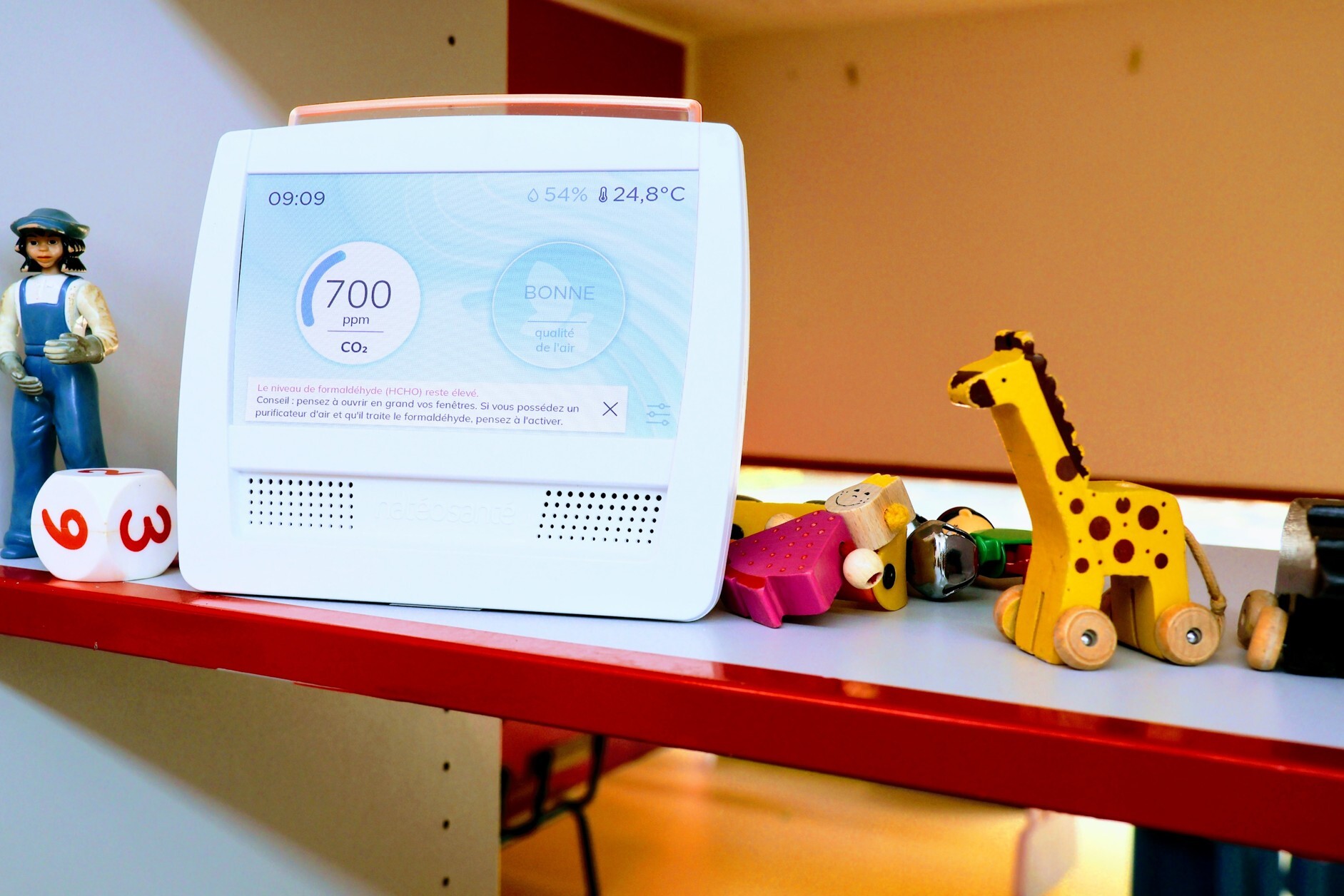
The Air Coach connected station allows for CO₂ measurements to be taken in the various rooms selected for the annual assessment. It can be moved from one room to another to adjust the number of sensors to suit the facility’s layout and infrastructure.
In addition to the recorded value, the history allows you to visualize CO₂ trends during occupancy and the effect of ventilation measures.
Air Coach also monitors PM1, PM2.5, PM10, VOCs, formaldehyde, temperature, and humidity. This additional data provides a more comprehensive view of the indoor environment, without replacing regulatory monitoring programs when they are required.
A digital platform to centralize the process
The NatéoSanté platform allows you to compile, on a school-by-school basis, the annual assessment of ventilation systems, measurements, self-assessments, and action plans.
This gives the manager a consolidated view of their assets while maintaining the detail and traceability of each institution: an approach that is particularly useful for tracking deadlines and avoiding a fragmented management process spread across separate spreadsheets, statements, and documents.
From Compliance to Air Quality Management
A room where levels regularly exceed 800 ppm, a building that stands out from the rest, or the measurable effect of a new ventilation practice all become directly actionable insights.
The goal, therefore, is not merely to “conduct the annual assessment,” but to transform the data and regulatory requirements into a useful monitoring tool for prioritizing actions and verifying their effectiveness.
For local governments managing multiple facilities, the solution can be scaled based on the number of public access buildings, the number of rooms to be assessed, and the organization of measurement campaigns.
Would you like to simplify air quality monitoring at your facilities?
Contact us to determine the best setup and number of sensors for your facility.
Sources: Environmental Code, Articles R. 221-30 through R. 221-37. / Decree No. 2022-1689 of December 27, 2022, amending the Environmental Code with regard to indoor air quality monitoring. / Decree No. 2022-1690 of December 27, 2022, amending Decree No. 2012-14 of January 5, 2012. / Order of December 27, 2022, establishing the conditions for conducting direct-reading measurements of carbon dioxide concentrations in indoor air. / Cerema Guide and FAQs regarding the regulatory monitoring of indoor air quality in certain public access buildings.
You might also be interested in

SF2H Recommendations: Air Quality, CO₂, and Prevention of Healthcare-Associated Infections
Learn how the 2024 SF2H recommendations emphasize the role of air quality, CO₂, ventilation, and portable air-purifying devices in preventing healthcare-associated infections.

Podiatrists: Occupational Risks Related to Indoor Air Quality and Prevention Strategies
VOCs, fine particulate matter, aerosols: What are the real risks associated with air quality in podiatry offices, and how can they be assessed?

Healthcare-Associated Infections and Air Quality: Which Hospital Departments Will Be Most at Risk in 2026?
Which hospital departments are most at risk for healthcare-associated infections? Data for 2024–2025, antibiotic resistance, air quality, and HEPA filtration.
Veterinary Clinics: What Are the Risks to Staff and Animals Related to Indoor Air Quality?
Anesthetic gases, VOCs, fine particulate matter, formaldehyde, bioaerosols… What pollutants are found in a veterinary clinic, and how can exposure be minimized?